The 7-iron loft study: how iron lofts changed since 1982
We took the factory 7-iron and pitching wedge lofts for 98 iron sets from the manufacturers' own specification charts. 58 sets have a model year stated by their source, and we plot those over time. 50 sets from 10 brands were on the manufacturers' US sites in 2025–2026, and they show what is on sale now. You can reuse the figures, the chart and the raw data with a credit link.
Median of 7 dated sets
Median of 50 sets
7° between the strongest and weakest
Median, against 47° in the 1982–2001 charts
Key findings
- The typical 7-iron is 3.5° stronger. The median dated chart from 1982–2001 lists a 34.5° 7-iron. The median set on sale in 2025–26 lists 31°.
- Today's spread is twice that change. 7-irons on sale in 2025–26 run from 27° to 34°, a 7° range. Which set you buy changes the 7-iron loft more than which decade it comes from.
- One brand can cover the whole range. Cobra's current sets run from 27° (Cobra KING TEC X irons) to 34° (Cobra 3DP MB irons).
- The strongest new 7-iron has old 5-iron loft. The Cobra KING TEC X irons list a 27° 7-iron, the same loft as the 5-iron in the 1992 PING Zing irons chart.
- Pitching wedges got stronger too. The median PW moved from 47° to 44° (3°), and the strongest current PW is 40°. 38 of the 50 current charts list a gap, approach or utility wedge in the iron range.
- Irons got longer as well. Every 1982–2001 chart lists a 36.75 in 7-iron. The median current set lists 37.25 in.
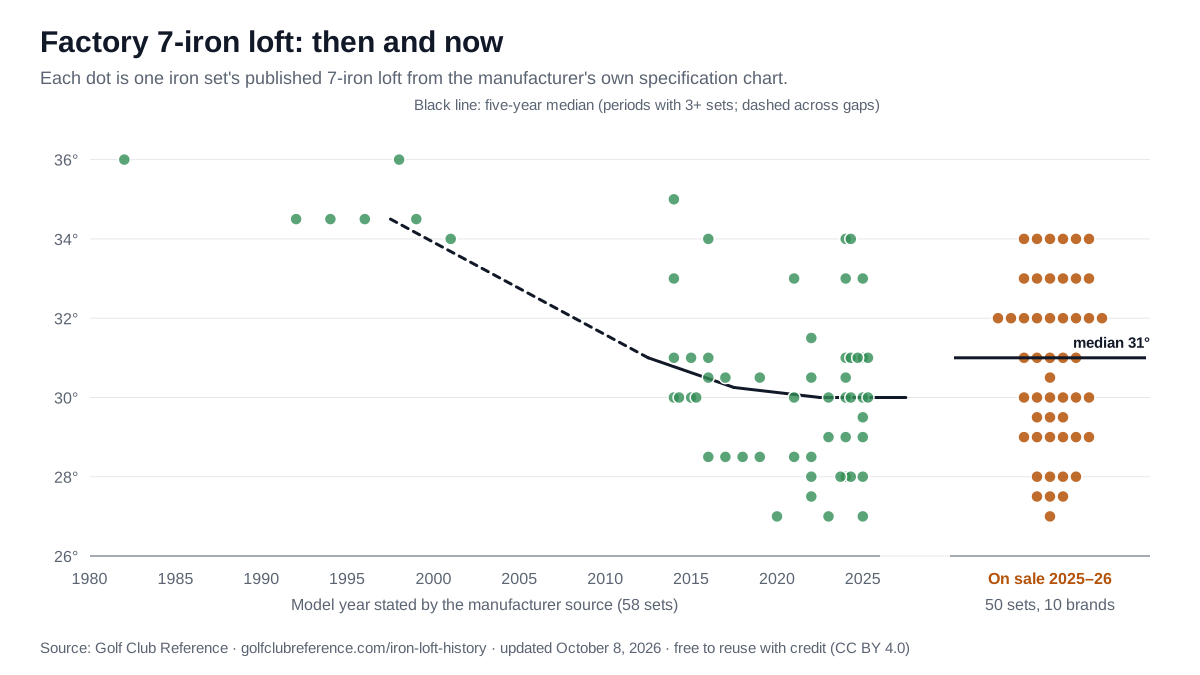
7-iron loft by model year
Only sets with a model year stated by their source are on this time axis. The 2025–26 sets without a stated year are in the next section. Select a dot to open the set's full factory chart.
What the chart shows
The oldest chart here, the PING Eye 2 irons from 1982, lists a 36° 7-iron and a 50.5° pitching wedge. Across the five-year periods with at least three sets, the median 7-iron moves from 34.5° in 1995–1999 to 30° in 2025. Golfers often call this trend “loft jacking”: a modern 7-iron can carry the loft of an older 5- or 6-iron while keeping the 7 on its sole.
The spread within a single year is as important as the trend. Players' blades and game-improvement irons from the same season can differ by several degrees, so a set's design explains much of its loft. Switch the chart to the pitching wedge to see why many newer sets add a gap wedge below the PW.
On sale in 2025–26: 27° to 34° at the 7-iron
These are the 50 sets in our database that were on a manufacturer's US site in 2025 or 2026. Each row is a brand and each dot is one set's factory 7-iron loft. The strongest lofts belong to the Cobra KING TEC X irons; the weakest to the Cobra 3DP MB irons, Mizuno Pro S-1 irons, Mizuno Pro S-3 irons, Mizuno Pro S-4 irons, Wilson Staff Model Blade irons and Wilson Staff Model CB irons.
All 50 sets on sale in 2025–26
Which old club has today's 7-iron loft?
The table matches each classic dated chart against two modern figures: the median 2025–26 7-iron (31°) and the strongest (27°). In all 7 classic charts, the median modern 7-iron loft sits closest to the 6-iron. In 6 of them, the strongest modern 7-iron sits closest to the 5-iron. Ties go to the weaker club, so the table never overstates the shift.
| Classic set | Its 7-iron | Closest to 31° | Closest to 27° |
|---|---|---|---|
| 1982 PING Eye 2 irons | 36° | 6-iron (32°) | 5-iron (28.5°) |
| 1992 PING Zing irons | 34.5° | 6-iron (30.5°) | 5-iron (27°) |
| 1994 PING Zing 2 irons | 34.5° | 6-iron (30.5°) | 5-iron (27°) |
| 1996 PING ISI irons | 34.5° | 6-iron (30.5°) | 5-iron (27°) |
| 1998 Ben Hogan Apex irons | 36° | 6-iron (32.5°) | 4-iron (25.5°) |
| 1999 PING i3 Blade and O-Size irons | 34.5° | 6-iron (30.5°) | 5-iron (27°) |
| 2001 Ben Hogan Apex Edge irons | 34° | 6-iron (30°) | 5-iron (26°) |
Pitching wedges and the extra wedge
The classic charts list pitching wedges from 46° to 50.5°. The 2025–26 sets list 40° to 46°, with a median of 44°. A stronger PW leaves a bigger loft gap to a sand wedge, and 38 of the 50 current charts fill it with a GW, AW, UW or U club in the iron range itself.
If you are mixing an older set with newer wedges, or the other way round, check the gaps with the wedge gap planner and read how wedge lofts fit together.
Longer as well as stronger
All 7 classic charts list a 36.75 in 7-iron. The current sets run from 36.5 in to 37.5 in, with a median of 37.25 in. Stock lengths are the manufacturer's standard build; a used set may have been cut or extended. The club length guide explains how to check yours.
What loft does not tell you
Loft alone does not tell you how far a club goes. Head design, shaft, strike and delivery all change ball flight, and a used club may have been bent away from its factory loft. Use these figures to identify a set and compare original builds, then have the actual clubs measured when it matters.
How the data was chosen
- Only iron sets with a full manufacturer loft chart in our database are included. Every row in the download links to its source.
- The time chart uses only sets whose source states a model year or introduction year. 140 charts are left off the time axis because their source gives a generation code or an archive date instead, and we do not guess release years. To match an undated set by its name, era or loft, use the what year are my irons finder.
- “On sale in 2025–26” means a model year of 2025 or later, or a manufacturer US product page reviewed in 2026. A product page shows that a set was on sale; it is not a release year. Some 2025 sets appear in both groups.
- The classic baseline is the 7 dated charts from 1982 to 2001, all from PING and Ben Hogan. That is a small sample from two brands, so read it as a baseline for those sets rather than for the whole market.
- All figures are standard factory lofts for the stated build. Alternative loft options, such as PING's Power Spec, are not used. Summary figures are medians, not averages.
- This is our catalog, not a sample of every iron sold. Coverage of the 1980s and 1990s is thinner than recent years.
Use this data
You are welcome to republish the chart and the figures on this page, in print or online, under the Creative Commons Attribution 4.0 license. Please credit Golf Club Reference and link to this page.
Suggested citation
Golf Club Reference (2026). The 7-iron loft study: how iron lofts changed since 1982. Updated October 8, 2026. https://golfclubreference.com/iron-loft-history
Found an error, or want a set added? Send us the model and we will check it against the manufacturer's chart.