The number on a fairway wood or hybrid tells you its place in the line, and the loft follows it closely. The median 3-wood in our catalog has 15° of loft, and each step through the odd numbers adds 3°: 18° for a 5-wood, 21° for a 7-wood, 24° for a 9-wood and 27° for an 11-wood. Hybrids run from 17° for a 2-hybrid to 33° for an 8-hybrid, 2° to 3° apart, with the 3-hybrid at 19°, the 4-hybrid at 22° and the 5-hybrid at 25°.
Those are medians of the lofts manufacturers publish for 91 fairway wood and 74 hybrid models from 9 brands, counted head by head wherever the maker names the head that carries each loft. They are factory specifications, not measurements of real clubs, and the same number can carry a different loft in another line, so the tables also give the spread between models.
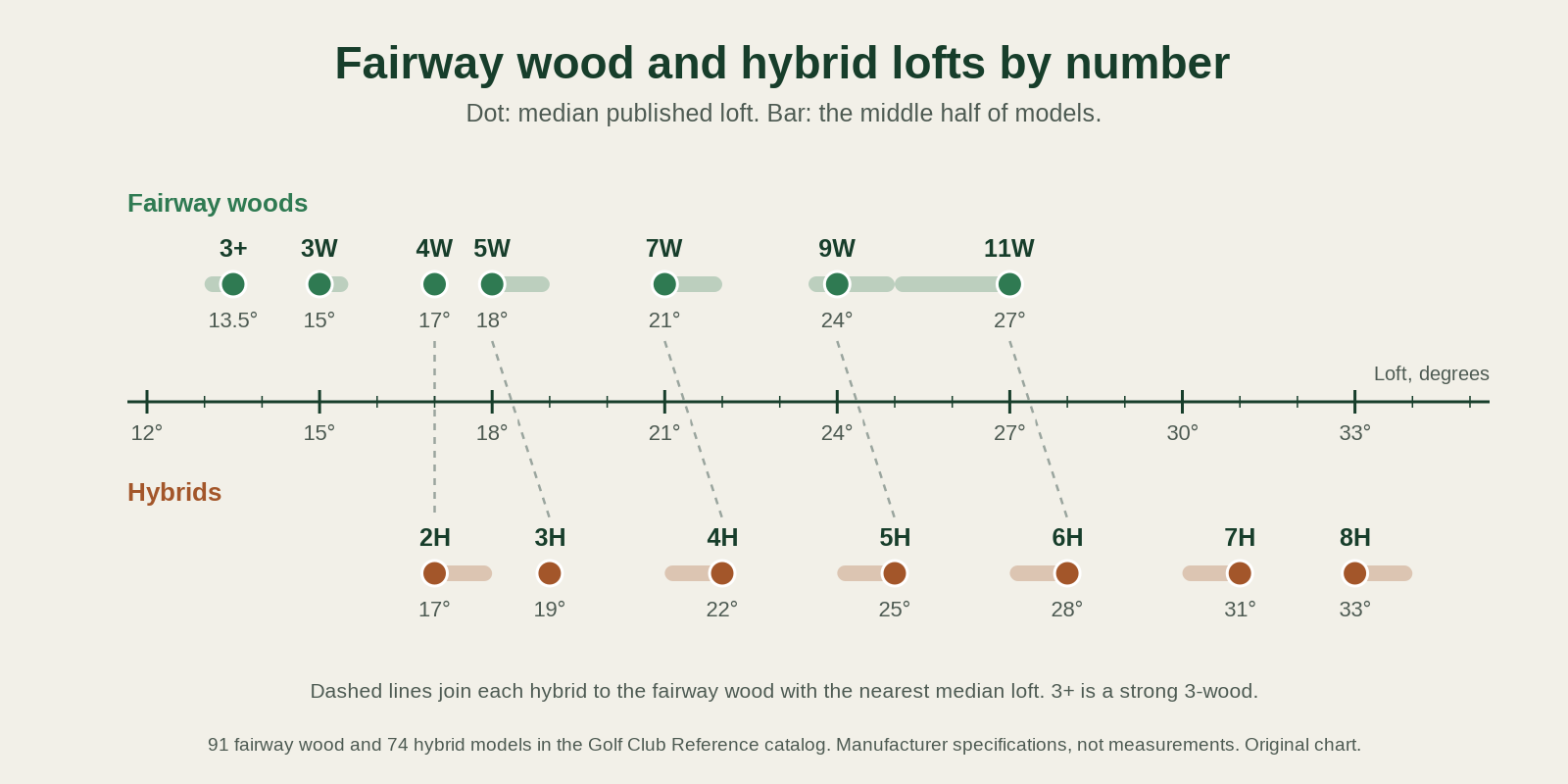
Fairway wood loft chart
| Fairway wood | Median loft | Middle half of models | Lowest to highest | Models (brands) |
|---|---|---|---|---|
| 3+ (strong 3-wood) | 13.5° | 13°–13.5° | 13°–13.5° | 9 (5 brands) |
| 3-wood | 15° | 15°–15.5° | 14.5°–19° | 90 (9 brands) |
| 4-wood | 17° | 17° | 16.5°–17° | 11 (5 brands) |
| 5-wood | 18° | 18°–19° | 17°–23° | 87 (9 brands) |
| 7-wood | 21° | 21°–22° | 20°–28° | 74 (9 brands) |
| 9-wood | 24° | 23.5°–25° | 23°–33° | 35 (6 brands) |
| 11-wood | 27° | 25°–27° | 25°–27° | 11 (3 brands) |
"Middle half" leaves out the quarter of models with the strongest lofts and the quarter with the weakest, so it shows where most lines sit. Most 3-woods are 15°: 53 of the 90 3-woods in the table list exactly that. The middle half of 5-woods is 18°–19°, and of 7-woods 21°–22°. The 4-wood (17°) and the 11-wood (27°) are less common: 11 models offer a 4-wood and 11 an 11-wood.
A 3+ (PING calls its version a strong 3-wood) has 13°–13.5°, between a driver and a standard 3-wood. Some lines also name a head between the numbers instead of numbering it. Callaway's 3HL is 16.5° in the 9 lines that list it, Cobra's 3 HF is 16° to 16.5°, and Callaway's Heavenwood, which sits between the 5-wood and the 7-wood, is 20° to 21°. These named heads are not counted in the numbered rows.
Hybrid loft chart
| Hybrid | Median loft | Middle half of models | Lowest to highest | Models (brands) |
|---|---|---|---|---|
| 2-hybrid | 17° | 17°–18° | 16°–18° | 34 (8 brands) |
| 3-hybrid | 19° | 19° | 18°–21° | 67 (9 brands) |
| 4-hybrid | 22° | 21°–22° | 19°–24° | 74 (9 brands) |
| 5-hybrid | 25° | 24°–25° | 22°–27° | 71 (9 brands) |
| 6-hybrid | 28° | 27°–28° | 25°–31° | 48 (9 brands) |
| 7-hybrid | 31° | 30°–31° | 28°–35° | 24 (7 brands) |
| 8-hybrid | 33° | 33°–34° | 31°–39° | 12 (3 brands) |
Hybrids are numbered after the iron they were designed to replace in their maker's line. Every one of the 74 hybrid models offers a 4-hybrid. The 5-hybrid is in 71 of them and the 3-hybrid in 67, and 42 of those 3-hybrids list 19°. Fewer lines go past the 5-hybrid (48 models offer a 6-hybrid, 24 a 7-hybrid and 12 an 8-hybrid), and an 8-hybrid can be anything from 31° to 39°. A 1-hybrid (16°) appears in only 3 models, too few for a row; the tables need at least 5.
7-wood or 4-hybrid? Fairway woods, hybrids and irons with the same loft
| Hybrid | Median loft | Fairway wood with the nearest loft | Same-number iron, 2018 or later | Same-number iron, before 2010 |
|---|---|---|---|---|
| 2-hybrid | 17° | 4-wood, 17° | Not in our iron charts | Not in our iron charts |
| 3-hybrid | 19° | 5-wood, 18° | 3-iron, 19.5° | 3-iron, 21° |
| 4-hybrid | 22° | 7-wood, 21° | 4-iron, 21° | 4-iron, 24° |
| 5-hybrid | 25° | 9-wood, 24° | 5-iron, 23.5° | 5-iron, 27° |
| 6-hybrid | 28° | 11-wood, 27° | 6-iron, 26.5° | 6-iron, 30.75° |
| 7-hybrid | 31° | None within 1.5° | 7-iron, 30.25° | 7-iron, 34.5° |
| 8-hybrid | 33° | None within 1.5° | 8-iron, 34.5° | 8-iron, 38.75° |
The table pairs each hybrid with the fairway wood whose median loft is nearest, when one is within 1.5°. A 7-wood (21°) and a 4-hybrid (22°) are close in loft, and so are a 9-wood (24°) and a 5-hybrid (25°). The clubs still differ in build. Fairway woods are built longer: the middle half of published fairway wood lengths in our records is 42–43 in, against 39–40.5 in for hybrids, across all heads.
Against irons, a hybrid's number is a rough guide. In iron sets dated 2018 or later, the median 4-iron is 21° and the median 5-iron 23.5°, so the 4-hybrid (22°) and the 5-hybrid (25°) are both weaker than the modern irons with their numbers. In sets from before 2010 the 4-iron was 24° and the 5-iron 27°, so the 4-hybrid (22°) and the 5-hybrid (25°) are both stronger than the older irons with their numbers. Our golf club loft chart shows how iron lofts changed by era, and the loft gap checker lays out the lofts of your own clubs side by side.
Loft is only one input. Two clubs with the same loft can launch and carry differently because of shaft length, head design and how you swing them, and nothing on this page predicts distance.
Why your 5-wood or 4-hybrid can have a different loft
Makers place the same number differently. Across the models in the table, the 5-wood runs from 17° to 23° and the 7-wood from 20° to 28°.
Women's lines sit at the weak end. PING's archived G Le2 page names its G Le models as women's fairway woods, and across the 4 G Le generations the 3-wood is 18° to 19° and the 9-wood 28° to 33°, the weakest 9-wood in the table. They are counted in the tables.
8 of the fairway wood and hybrid records publish an adjustable loft range; Mizuno's JPX One fairway lists 13° to 17° for its 3-wood. On an adjustable head the loft on the sole is the standard setting, and the club in your hands may be set to something else. Titleist's SureFit chart shows how far each setting moves loft and lie.
Our TaylorMade and Titleist records list fairway wood and hybrid lofts without the head number, so those models are not in these tables, though each model page has its loft options.
How to find the loft of your fairway wood or hybrid
- Read the head. Most fairway woods and hybrids carry the number or the loft on the sole; adjustable heads also show a hosel setting.
- Find the model in our fairway wood records or hybrid records. Each page lists the published loft options and links its source. Lines that name their heads show which loft goes with which number, as on the Callaway Paradym fairway, Cobra OPTM X fairway and PING G430 hybrid pages.
- Compare the result with the clubs around it in your bag, with the loft gap checker or the printable golf club guide. Our types of golf clubs guide covers what each club in the bag is for.
Sources and limits
The tables are computed from the fairway wood and hybrid records in our catalog, checked on November 18, 2026. Each record links its manufacturer page or dataset source on its model page. 91 of the 180 fairway wood records and 74 of the 137 hybrid records say which head carries which loft, either next to each loft or in a list of heads in the same order. Records that list lofts without head names are left out, and so are 3 lists of head names that we could not match to the lofts in order. Callaway supplies 30 of the fairway wood models and 28 of the hybrid models, more than any other brand, so its lofts carry the most weight. The iron columns come from our iron set charts, grouped by the year of each chart.
Medians and ranges describe the specifications manufacturers publish, not a sample weighted by sales, and every kind of line is mixed in, women's lines included. Adjustable heads are counted at their standard setting. Nothing here is a measurement of a real club or a fitting recommendation.