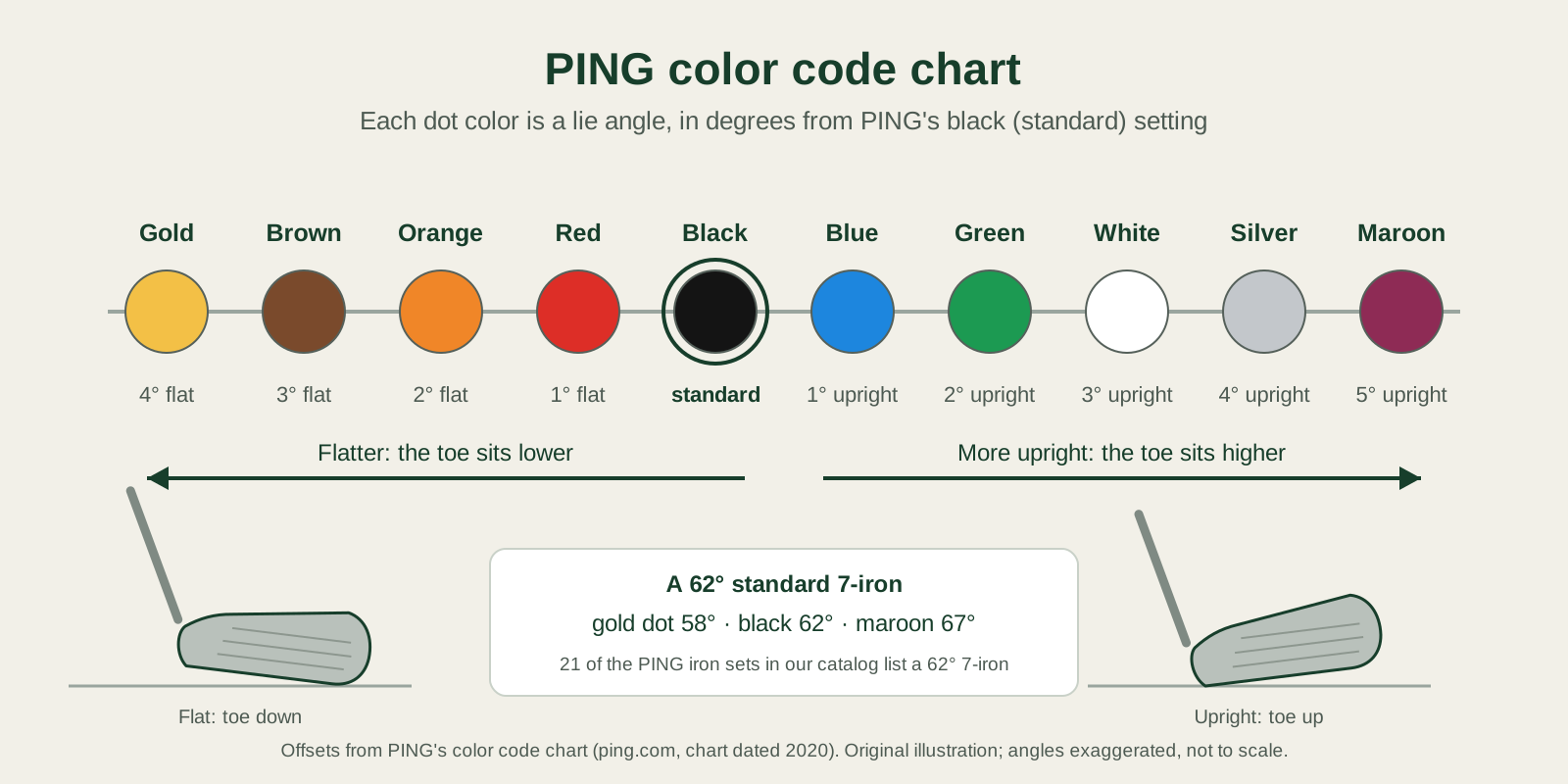
PING's color code is the colored dot on a PING iron that tells you its lie angle compared with PING's standard. Black is standard. The current chart has 10 colors, one degree apart, from maroon at 5° upright to gold at 4° flat. Blue, green, white, silver and maroon are upright; red, orange, brown and gold are flat. A blue-dot 7-iron sits 1° more upright than the same 7-iron with a black dot.
PING's specification tables give each club's lie angle for the black dot at standard length. On 21 of the 27 PING iron sets in our catalog, the black-dot 7-iron is 62°, so the same 7-iron is 58° with a gold dot and 67° with a maroon dot. Those figures are PING's published offsets added to PING's published standard lies, which makes them specifications. A used iron may have been bent since it was built.
PING color code chart
| Dot color | Lie compared with black | 7-iron at a 62° standard |
|---|---|---|
| Maroon | 5° upright | 67° |
| Silver | 4° upright | 66° |
| White | 3° upright | 65° |
| Green | 2° upright | 64° |
| Blue | 1° upright | 63° |
| Black | Standard | 62° |
| Red | 1° flat | 61° |
| Orange | 2° flat | 60° |
| Brown | 3° flat | 59° |
| Gold | 4° flat | 58° |
Upright means a larger lie angle, so the toe sits higher at address. Flat means a smaller angle and a lower toe. Our lie angle guide explains how the angle is measured. The offset works the same way through the set: a blue-dot 4-iron is 1° more upright than the black-dot 4-iron, and a blue-dot pitching wedge is 1° more upright than the black-dot pitching wedge.
The colors come from PING's Fitting Color Code Chart. PING's page says there are 10 color codes from 5° upright to 4° flat, shown by a colored dot on the iron head, and the chart on that page, an image dated 2020, prints the degrees for each color. PING's own fitting page from December 1998 lists the same ten colors with the same values.
What the black dot means on PING spec tables
PING's current iron pages, including the G430, i240 and Blueprint S, state with their specification tables that the lie angle is based on the Black Color Code at standard length. The PING Classics tables behind our older records, from the Eye 2 to the i3, use the black dot too. So the lie column on every PING model page in our catalog is the black-dot lie, and you add or subtract the dot's offset from it.
The dot describes lie only. PING also offers Power Spec and Retro Spec lofts, stronger and weaker than its standard lofts, and a dot cannot tell you which loft build a set has. Our G400 to G430 comparison covers those loft builds for the G-series.
PING lie angle chart by model
| Black 7-iron lie | PING iron sets in our catalog | Gold (4° flat) to maroon (5° upright) |
|---|---|---|
| 61° | G Le | 57° to 66° |
| 62° | Blueprint, Blueprint S, Blueprint T, G, G Le2, G Le3, G400, G410, G425, G430, G700, G710, G730, i59, i210, i230, i240, i500, i525, i530, iBlade | 58° to 67° |
| 62.5° | Eye 2, i3 Blade and O-Size | 58.5° to 67.5° |
| 63.5° | ISI, Zing, Zing 2 | 59.5° to 68.5° |
In our catalog, 21 of the 27 PING iron sets print a 62° black-dot 7-iron, and they also agree further down: all 21 list 62.8°, 63.5° and 64.1° for the 8-iron, 9-iron and pitching wedge. The long irons differ by model. Of the 18 sets in that group with a 4-iron, the black-dot 4-iron is 59.2° on 2 sets, 59.8° on 7 and 60.5° on 9, so look up the exact club on its model page before you add the dot's offset.
The most upright standard 7-iron in the table is 63.5°, on the ISI, the Zing and the Zing 2, followed by 62.5° on the Eye 2 and the i3 Blade and O-Size. The flattest is 61°, on the G Le.
How PING's chart picks a color code
The chart is a static fitting. It plots a golfer's height against their wrist-to-floor measurement and reads a color code and a shaft length where the two meet. In PING's 1998 instructions you stand straight in street shoes on a hard floor with your arms relaxed, and someone measures from the first crease of your wrist to the floor. On the current chart, standard length covers heights from 5'7" to 6'0", and the length moves in half-inch steps from 1½" shorter at 5'0" to 1½" longer at 6'7". The 1998 chart moved in smaller steps, a quarter inch at a time around standard length.
PING calls the result a starting point. Its 1998 page said so in those words, and its 2008 glossary said a static fitting is accurate within one color code for 70% of golfers. In the next step a fitter has you hit balls off an impact board with tape on the sole. According to the glossary, a mark in the center of the tape shows the color code of an iron in the preferred impact position, though the golfer should choose the color code that gives the best ball flight. PING's 2004 page gave an example: a golfer whose measurements point to blue but who fades the ball might be fitted with green, or even white.
This page helps you read the dot on a club you already have. For your own color code, start with PING's chart and a fitter.
Old PING color codes: Eye 2 to today
PING dates its color coding system to 1972. The oldest PING description we found is its fitting page captured in December 1998, when the site covered both the Eye 2 and the ISI irons. It already listed ten colors one degree apart, with today's names in today's order: maroon at "+5° and up" and gold at "-4° and below". PING could build beyond both ends and marked those clubs with a number after the color. We found no PING chart from before 1998, so the exact angle behind the dot on an earlier Eye 2 is unknown. Measure the club if it matters.
PING tied the color to length on that 1998 page and again in 2004. A color's lie was set for a standard-length club, and when a club was built longer or shorter, PING changed the lie angle and kept the color. In PING's example, a green-dot iron at standard length was ¾° more upright than a green-dot iron built ½" longer. On an older set built long or short, the measured lie can therefore differ from the black lie plus the color's offset. The current chart gives one offset per color, lists length separately and does not mention a length correction.
The number of codes changed as well. PING's glossary said there were 12 color codes in 2008, and the same sentence was still there in 2010. PING's club repair order still offers two colors that are not on today's chart, yellow (listed between green and blue) and purple (between red and orange), along with maroon+, maroon++, gold- and gold-- beyond the ends. We have not found a PING page that gives the angle for any of those six, so we do not print one.
The right dot can also change from one model to the next. PING's 1998 page warned that a golfer playing black-dot Eye 2 irons might need a blue or green dot in the ISI series for similar results, because the ISI's perimeter weighting made the toe droop more during the swing. Our old PING irons by year article helps you name a classic head and find its table.
Woods used fewer colors. PING's 2003 fitting FAQ said its metal woods came in only three of them: green at 2° upright, black, and orange at 2° flat.
PING grip colors are a different chart
PING also color-codes its grips, and five of the grip colors (white, blue, red, gold and orange) share a name with a lie dot. A grip color gives the grip's size, read from the length of the hand and of the longest finger on the grip chart that sits on the same PING page. White carries no size offset; aqua, red and blue are 1/64", 1/32" and 1/16" smaller, and gold and orange 1/32" and 1/16" larger.
How to read the dot on a used PING iron
- Find the dot. On the older models in our catalog it sits on the back of the head, on the cavity badge of the Eye 2 and in the center of the ISI's cavity. The iBlade in the photo on our iBlade page has it on the hosel. Check every club in the set.
- Look up the black-dot lie for that club on its model page, then add or subtract the offset from the chart above.
- Treat the result as how the club was built. Irons can be bent after they leave PING, and PING's repair order notes that the color code a club can still reach depends on its model, its age and earlier adjustments. If lie matters to you, have it measured on a loft and lie machine.
- Measure the length as well. A club that was cut down or extended sits differently at address, and on older sets PING's lie for a given color depended on the length.
Our used iron checklist covers the rest of a used set, and the club length guide explains how to measure length the same way each time.
Sources and limits
The color offsets come from PING's Fitting Color Code Chart and the chart image on that page, dated 2020; the grip sizes come from the grip chart on the same page. The standard lies come from our catalog records of PING's specification tables, each linked from its model page. PING's G430, i240 and Blueprint S pages state that their lie angles assume the Black Color Code at standard length, and the yellow, purple and beyond-the-chart codes are from PING's club repair order. All were checked on November 16, 2026. The history comes from PING pages read through the Internet Archive on the same day: the fitting page and static color code chart captured in December 1998, the fitting FAQ of October 2003, the iron color code page of January 2004, the glossary of June 2008 and December 2010, and the fitting process page of July 2018 with PING's 1972 date. These are reference sources; PING has not reviewed or endorsed this page.
A lie with a dot on this page is a published offset added to a published standard lie, not a measurement of any club, and this page is not a fitting: PING itself calls the chart a starting point. We found no PING values for yellow, purple, maroon+, maroon++, gold- or gold--, no PING chart from before December 1998, and no PING list of the angles from the years when PING counted 12 codes, so we cannot confirm that every color carried exactly these angles in that period.