
The short answer
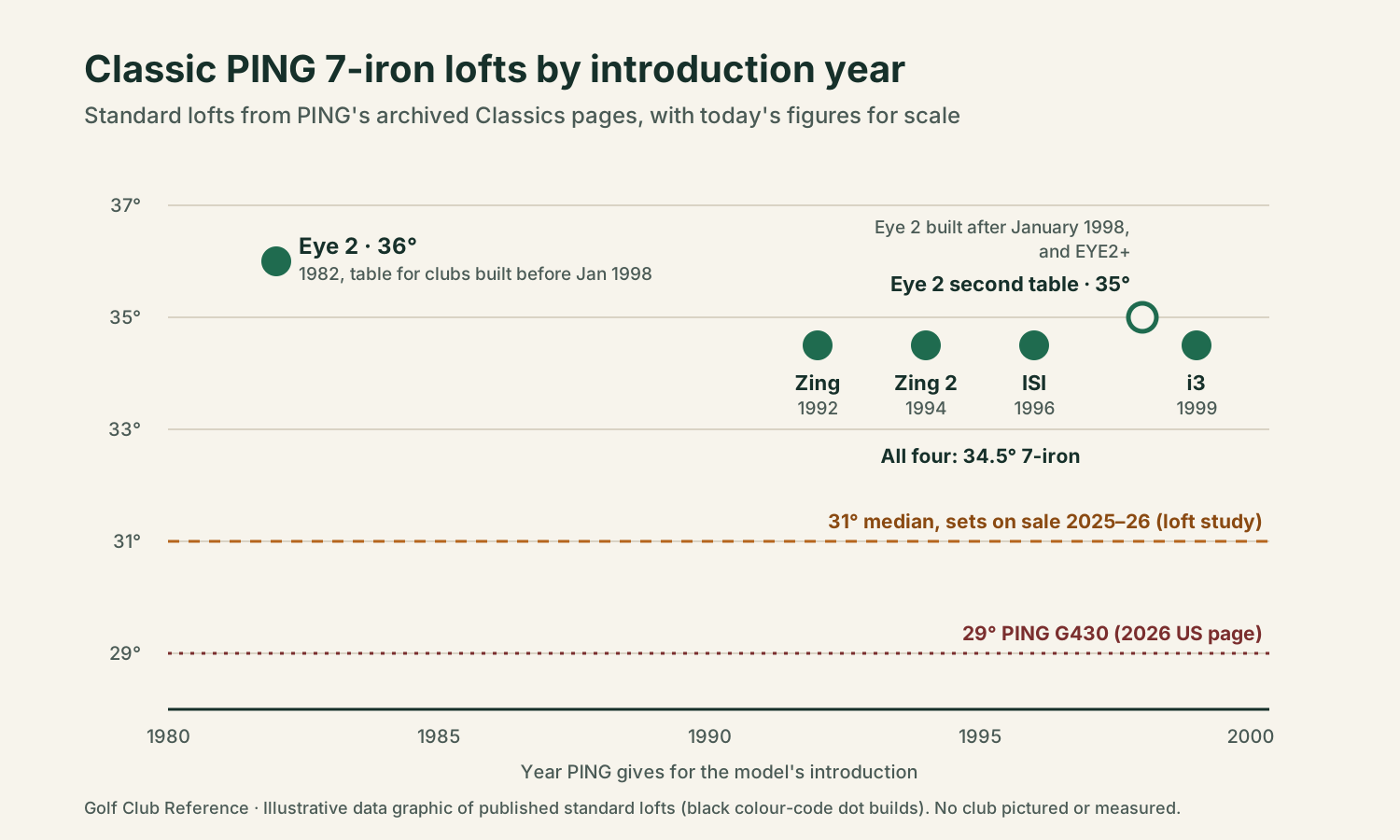
If the cavity says EYE2, PING introduced the model in September 1982. ZING dates from January 1992, ZING 2 from January 1994, the ISI series from 1996 and the i3 from 1999. Those are model years. They tell you when the design arrived, not when your particular set was built. A club from any of these lines may have been made later than its introduction year.
The lofts barely moved over those two decades. The Zing, Zing 2, ISI and i3 all list a 34.5° 7-iron and a 47° pitching wedge. The original Eye 2 table is weaker, with a 36° 7-iron and a 50.5° pitching wedge. Today's PING G430 lists a 29° 7-iron.
Classic PING irons by year
Standard factory lofts from each model's PING Classics page. All five list a 36.75-inch standard 7-iron, so length will not separate them either.
| Model | Introduced | 5-iron | 7-iron | 9-iron | PW |
|---|---|---|---|---|---|
| Eye 2 | Sept. 1982 | 28.5° | 36° | 45° | 50.5° |
| Zing | Jan. 1992 | 27° | 34.5° | 42.5° | 47° |
| Zing 2 | Jan. 1994 | 27° | 34.5° | 42.5° | 47° |
| ISI | 1996 | 27° | 34.5° | 42.5° | 47° |
| i3 | 1999 | 27° | 34.5° | 42.5° | 47° |
The Eye 2 row is PING's table for clubs built before January 1998. ISI and i3 label the pitching wedge W; it appears as PW here so the rows line up. Each model page carries the complete chart, including the long irons, every wedge, lie angles and lengths.
Read the badge first
Four of the five charts share the same core lofts, so the numbers cannot tell these sets apart, but the cavity badge can. PING's own pages and product photos show these markings:
- Eye 2: PING and EYE2 sit either side of a color-code dot, with KARSTEN PHOENIX AZ lettered along the lower cavity.
- Zing: PING and ZING either side of the dot, PHOENIX above and KARSTEN along the bottom. PING also describes a deeply indented trailing edge.
- Zing 2: the badge reads PING ZING 2 beside the dot, with KARSTEN along the lower cavity.
- ISI: ISI lettering across a cavity with five fingers radiating from a central color-code dot.
- i3: an oval gold i3 badge above PING, with BLADE or O-SIZE lettered below.
Shaft bands and grips are weak evidence on a set this old, since either may have been replaced. If the badge is worn, our photo checklist for older irons covers what else to photograph, and the PING iron year finder narrows our PING records by name, era or a measured 7-iron loft.
Eye 2: two loft tables for one name
The Eye 2 is the one model where the name alone does not settle the lofts. PING's Classics page publishes two tables. Clubs built before January 1998 follow the original: 36° 7-iron, 45° 9-iron, 50.5° pitching wedge. PING's second table covers Eye 2 irons built after January 1998 and the EYE2+, with stronger lofts: a 35° 7-iron, 44° 9-iron and 48.5° pitching wedge. The lie and length figures are the same in both.
PING also notes that the Eye 2 went through dozens of minor and a few major revisions between September 1982 and the EYE2+ of April 1990, and that the lob wedge joined the set in March 1986. So two sets with the same badge can differ in detail. If the build date is unknown, measuring one iron's loft is the practical way to see which table it matches, keeping in mind that a single bent club can mislead you.
Zing vs. Zing 2: the same lofts
The Zing and Zing 2 tables list identical lofts and lengths from the 1-iron to the sand wedge. The only published difference in the standard rows is the 5-iron lie: 61.5° on the Zing page and 62° on the Zing 2 page. That is too small to identify a used club, so read the badge.
One row needs care. PING's Zing table lists its lob wedge at 57°, the same loft as its LS wedge, while the Zing 2 table gives a 61° LW. We leave the Zing LW out of our record until a second source confirms it.
ISI and i3: watch the wedge names
The ISI series covers several heads under one table: the copper ISI and nickel ISI-N from 1996, then the oversized stainless ISI-K and a compact stainless ISI. Finish and the letter after ISI tell them apart. Its wedges carry PING's own names: W at 47°, W2 at 49.5°, S at 52°, S2 at 54.5°, S3 at 57° and L at 61°.
The i3 came in Blade and O-Size heads that share lofts, lies and lengths. They differ in offset and bounce: PING lists 0.07″ of offset and 7° of bounce on the Blade 7-iron, and 0.21″ with 10.5° on the O-Size. Its wedges are W at 47°, U at 52°, S at 56° and L at 60°. The later i3+ is a separate model with its own specifications and is not covered here.
So a letter on a used PING wedge only makes sense once you know the model: an S on an ISI is 52°, and an S on an i3 is 56°.
Compared with today's lofts
The 34.5° 7-iron shared by the Zing, Zing 2, ISI and i3 is 3.5° weaker than the 31° median of the 50 sets on sale in 2025 and 2026 in our 7-iron loft study, and 5.5° weaker than the G430. The pitching wedge moved further: 47° on the classic charts against 41° on the G430. Our G400 to G430 comparison shows the more recent PING steps.
Loft is only part of the picture. Head design, shaft, strike and delivery all change ball flight, so these figures do not tell you how far any of these clubs will carry. The lie angles in our records are PING's standard for the black color-code dot; a set fitted with another dot was built flatter or more upright, as our lie angle guide explains.
Sources and limits
Figures come from our catalog records of PING's US Classics pages, read through Internet Archive captures and retrieved October 8, 2026: Eye 2 (capture dated October 12, 2003), Zing, Zing 2, ISI and i3 (captures dated September 8, 2003). The G430 figures are from PING's current US page. PING lists lengths in fractional inches; the catalog stores them as decimals.
Introduction years are PING's, and they date the model, not an individual club. This article does not decode serial numbers, value a set or judge whether it suits anyone. We tested and measured no clubs, and a used iron may have been bent, reshafted, shortened or otherwise modified since it left the factory. All of PING's classic charts in our catalog are on the PING iron page.