
The short answer
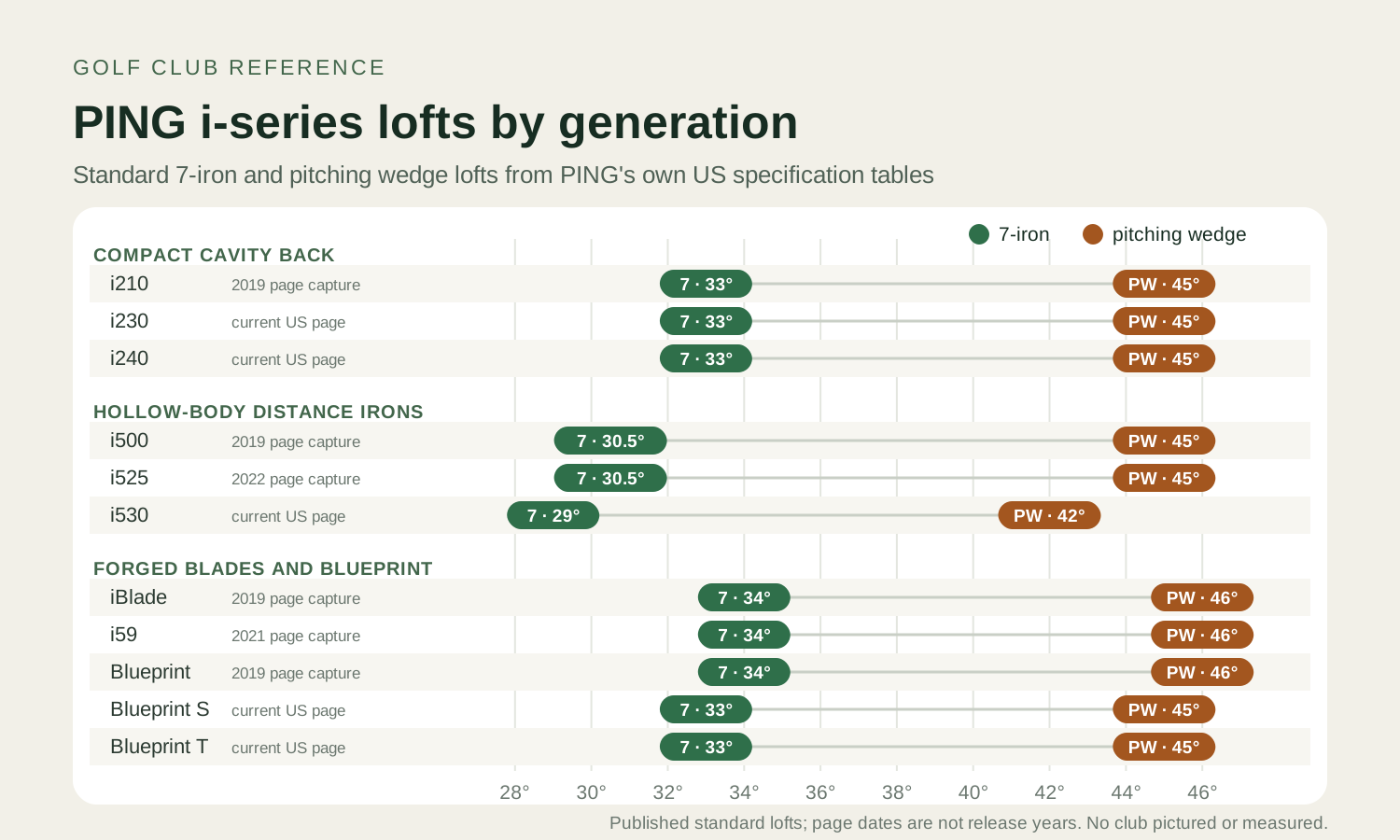
- i210, i230, i240. One standard loft row for all three, from a 19° 3-iron to a 50° UW. The i210 lies are more upright in the long irons, and the i230 table lists longer 4- to 6-irons than the other two.
- i500, i525, i530. The i500 and i525 tables are identical: an 18° 3-iron, 30.5° 7-iron, 45° PW and 50° UW. The i530 drops the 3-iron and is 1.5° to 3° stronger at every club: 29° 7-iron, 42° PW, 47° UW.
- iBlade, i59, Blueprint. The iBlade and i59 tables are identical: a 20° 3-iron, 34° 7-iron and 46° PW, with no UW row. The 2019 Blueprint page prints those lofts and adds a 17.5° 2-iron. The current Blueprint S and T are 1° stronger at every club, which lands on the i230's lofts.
So within each line the standard lofts stayed put from one generation to the next, apart from the step from the i525 to the i530. If a used set's 7-iron measures something else, suspect a Power Spec or Retro Spec build, bending or wear before you suspect a different model.
Standard lofts side by side
Standard lofts as printed in PING's US specification tables. The model names link to the full chart with the lie and length rows, the source and the notes for each set.
| Model | Source | 3 | 4 | 5 | 6 | 7 | 8 | 9 | PW | UW |
|---|---|---|---|---|---|---|---|---|---|---|
| i210 | US page captured 2019 | 19° | 22.5° | 26° | 29.5° | 33° | 37° | 41° | 45° | 50° |
| i230 | current US page | 19° | 22.5° | 26° | 29.5° | 33° | 37° | 41° | 45° | 50° |
| i240 | current US page | 19° | 22.5° | 26° | 29.5° | 33° | 37° | 41° | 45° | 50° |
| Model | Source | 3 | 4 | 5 | 6 | 7 | 8 | 9 | PW | UW |
|---|---|---|---|---|---|---|---|---|---|---|
| i500 | US page captured 2019 | 18° | 21° | 24° | 27° | 30.5° | 35° | 40° | 45° | 50° |
| i525 | US page captured 2022 | 18° | 21° | 24° | 27° | 30.5° | 35° | 40° | 45° | 50° |
| i530 | current US page | – | 19° | 22° | 25.5° | 29° | 33° | 37° | 42° | 47° |
| Model | Source | 2 | 3 | 4 | 5 | 6 | 7 | 8 | 9 | PW |
|---|---|---|---|---|---|---|---|---|---|---|
| iBlade | US page captured 2019 | – | 20° | 23.5° | 27° | 30.5° | 34° | 38° | 42° | 46° |
| i59 | US page captured 2021 | – | 20° | 23.5° | 27° | 30.5° | 34° | 38° | 42° | 46° |
| Blueprint | US page captured 2019 | 17.5° | 20° | 23.5° | 27° | 30.5° | 34° | 38° | 42° | 46° |
| Blueprint S | current US page | – | 19° | 22.5° | 26° | 29.5° | 33° | 37° | 41° | 45° |
| Blueprint T | current US page | – | 19° | 22.5° | 26° | 29.5° | 33° | 37° | 41° | 45° |
Across all 11 sets the 7-iron sits at one of four lofts: 34° (iBlade, i59 and Blueprint), 33° (i210, i230, i240, Blueprint S and Blueprint T), 30.5° (i500 and i525), 29° (i530). Our 7-iron loft study puts those figures against the rest of the market, and the iron loft finder lists every chart in the catalog by loft.
i210, i230 and i240: one loft row, two lie rows
The three compact cavity-back sets print the same loft at every club. What separates their tables is the lie row. The i210 page lists 60°, 60.5°, 61° and 61.5° at the 3- to 6-iron, where the i230 and i240 list 59°, 59.8°, 60.5° and 61.3°. The i210 is 1° more upright at the 3-iron, 0.7° at the 4, 0.5° at the 5 and 0.2° at the 6. From the 62° 7-iron down, all three agree. PING fits lie with a colored dot and the standard row assumes the black dot, so a used set with another dot was built flatter or more upright anyway. Our lie angle guide explains what the number means.
Length is the other difference. The i210 and i240 print the same length row, from a 39 in 3-iron in half-inch steps to a 37 in 7-iron. The i230 table lists 38.875 in, 38.25 in and 37.625 in for the 4-, 5- and 6-iron. That is 3/8, 1/4 and 1/8 in longer, and the same three figures the i500, i525 and i530 tables print. We could not reopen PING's page from this session to recheck it, so measure a used i230 rather than assuming either row. The iron comparison tool shows any two of these charts row by row.
i500, i525 and i530: where the lofts moved
The i500 and i525 pages print identical tables, the same lofts, lies and lengths, from an 18° 3-iron to a 50° UW, with a 30.5° 7-iron and a 45° PW. Nothing in the chart tells an i500 from an i525. The name on the back does; see the cues below.
The i530 is different. Its table starts at the 4-iron, and every club is stronger than the i525: 2° at the 4- and 5-iron, 1.5° at the 6 and 7, 2° at the 8 and 3° from the 9-iron to the UW. The 7-iron is 29°, the same figure PING prints for its G430, and the UW is 47° where the i525 lists 50°. Its lie and length rows match the i525 from the 4-iron down.
Set against the compact line, the gap is wide: an i240 7-iron is 33° and an i530 7-iron 29°, 4° apart under the same i prefix, and at the PW it is 45° against 42°. The loft gap checker shows what that does to the spacing if the two are mixed in one bag.
iBlade, i59 and Blueprint: the 34° and 33° charts
The iBlade and the i59 print one table: a 20° 3-iron, a 34° 7-iron and a 46° PW, with no UW row, on the i230's lie row and the i210's length row. Every club is 1° weaker than the matching i210 club. The 2019 Blueprint page prints those same lofts and adds a 17.5° 2-iron; its lengths run 1/4 in shorter from the 3-iron to the 9-iron, with the PW at 35.5 in on both.
The current Blueprint S and Blueprint T print a loft row 1° stronger at every club, 19° to 45°, which is the i230 and i240 row without the UW. The S and T share lofts and lies; the S uses the i210's length row, and the T keeps the 2019 Blueprint's shorter lengths. So a Blueprint with no S or T on the head belongs to the weaker-lofted 2019 chart, not to a variant of the current one.
Power Spec and Retro Spec change the numbers
PING's pages list two alternative factory loft builds beside the standard column: Power Spec is stronger, Retro Spec weaker. Our model notes record the 7-iron and pitching wedge for each:
| Model | Standard | Power Spec | Retro Spec |
|---|---|---|---|
| i210 | 33° / 45° | 31.5° / 44.5° | 35° / 47° |
| i230 | 33° / 45° | 31.5° / 44.5° | 35° / 47° |
| i240 | 33° / 45° | 31.5° / 44.5° | 35° / 47° |
| i500 | 30.5° / 45° | 29° / 44° | 32.5° / 47° |
| i525 | 30.5° / 45° | 29° / 44° | 32.5° / 47° |
| i530 | 29° / 42° | 27.5° / 41° | 31° / 42.5° |
| iBlade | 34° / 46° | 32° / 45° | not listed |
| i59 | 34° / 46° | 32° / 45° | 36° / 48° |
| Blueprint | 34° / 46° | 32° / 45° | not listed |
| Blueprint S | 33° / 45° | 31.5° / 44.5° | 35° / 47° |
| Blueprint T | 33° / 45° | 31.5° / 44.5° | 35° / 47° |
The builds overlap across models. An i230 ordered in Power Spec has a 31.5° 7-iron, 1° weaker than a standard i525; an i530 in Retro Spec, at 31°, is 0.5° from it; an i59 in Retro Spec, at 36°, is weaker than any standard 7-iron in this family. A measured 7-iron loft therefore cannot name the model. The build is not part of the model name, so ask which build a set was ordered in, or have the lofts measured. Our G400 to G430 comparison shows the same overlap in PING's game-improvement line.
Telling the heads apart
Because the charts repeat, the back of the head is what separates an i210 from an i230, an i500 from an i525 or an iBlade from an i59. These are the cues recorded on our model pages, read from PING's own product photos:
- i210. An i210 badge sits in the lower centre of a satin cavity.
- i230. Large i230 lettering runs across the upper back of the compact head.
- i240. PING sits above a black textured strip with red i240 lettering.
- i500. The back shows i500 lettering near the toe and FORGED lettering toward the heel.
- i525. A large i525 marking sits near the toe of the sculpted back.
- i530. The satin back shows i530 lettering near the lower toe.
- iBlade. iBLADE lettering sits near the top toe of a satin back; the pictured hosel also shows a blue colour-code dot, which marks a lie setting rather than the model.
- i59. An i59 marking sits near the toe with FORGED lettering toward the heel.
- Blueprint. PING appears above the muscle with BLUEPRINT near the heel and FORGED toward the toe.
- Blueprint S. BLUEPRINT appears near the top heel with FORGED lettering on the satin cavity panel.
- Blueprint T. The muscle back carries a BLUEPRINT T marking low on the blade.
A colored dot on the hosel is PING's lie code, not a model mark; the pictured iBlade carries a blue one. Our guide to identifying older irons covers what else to photograph, and the PING iron year finder narrows the catalog by name and loft. For PING's classic sets, from the Eye 2 to the i3, see our old PING irons by year article.
Checking a used PING i-series set
- Read the head. Photograph the back of each club and match the lettering to the list above. Do not identify the set from lofts, shafts or the box it came in.
- Open that model's chart. For an i500 or i525, an iBlade or i59, and an i210, i230 or i240, the standard lofts are the same either way; the lie and length rows are where the tables differ.
- Ask about the loft build. Standard, Power Spec and Retro Spec overlap between models, so the build needs its own answer.
- Record the color dot. Compare it with PING's chart and keep it separate from any measured lie.
- Measure length and lie. Two lie rows and three length rows run through these 11 tables. At the 4- to 6-iron, the i210, i240, iBlade, i59 and Blueprint S print 38.5 in, 38 in and 37.5 in; the i230, i500, i525 and i530 print 38.875 in, 38.25 in and 37.625 in; and the Blueprint and Blueprint T print 38.25 in, 37.75 in and 37.25 in. A measured length or lie that matches none of the rows for your model points to a custom build, a different dot or a modification. Our used-iron checklist covers what else to inspect.
PING labels the club after the pitching wedge UW. Our guide to golf club letters explains how that compares with other brands' AW and GW, and PING's iron page lists every PING chart in the catalog.
Sources and limits
Figures come from our catalog records of PING's US specification tables, retrieved October 7, 2026: the i210, i500, iBlade and Blueprint pages as captured by the Internet Archive in August 2019, the i59 (December 2021) and i525 (February 2022) captures, and PING's current i230, i240, i530, Blueprint S and Blueprint T pages; the G430 figure is from PING's current G430 page. Neither PING's site nor the archived pages were reopened for this article. It was written from the stored records, and every number on this page is generated from them, so a corrected record changes the text here too. PING prints lengths in fractional inches; the catalog stores decimals.
Page and capture dates say when a table was online, not when a set was released or built. None of these sources states a model year, so this article does not either. The cues above describe the heads in PING's product photos, not every finish or custom option. No clubs were inspected, measured or hit. Factory figures describe the original build; a used set may have been bent, reshafted or shortened, and loft alone doesn't say how far a club carries or whether it fits you. The strongest standard 7-iron here is 29° and the weakest 34°; what either does for your game is a fitting question, not a chart question.