
The short answer
We looked at the club each of our 198 factory iron charts lists directly below the pitching wedge:
- AW in 73 charts, at 46° to 51.5°. TaylorMade, Callaway, Srixon and Tour Edge use it.
- GW in 29 charts, at 47.5° to 51°: Mizuno, Cobra, Wilson and PXG.
- W in 28 charts, all Titleist, at 43° to 51°. Titleist's charts print the pitching wedge as P.
- UW in 15 PING charts, at 47° to 52°.
In most sets AW (approach wedge), GW (gap wedge) and UW are names for the same slot. The letters only tell you where to look in the right maker's chart. 39 of the charts stop at the pitching wedge, so a set that runs past PW may include a separately bought wedge.
Golf club letters by brand
The labels below are the ones printed in each maker's own specification table. Our model pages store PING's W, Titleist's P and Ben Hogan's Equalizer as PW so that sets line up in our tools; the notes on each page record the original label.
| Brand | Labels after the 9-iron | Example |
|---|---|---|
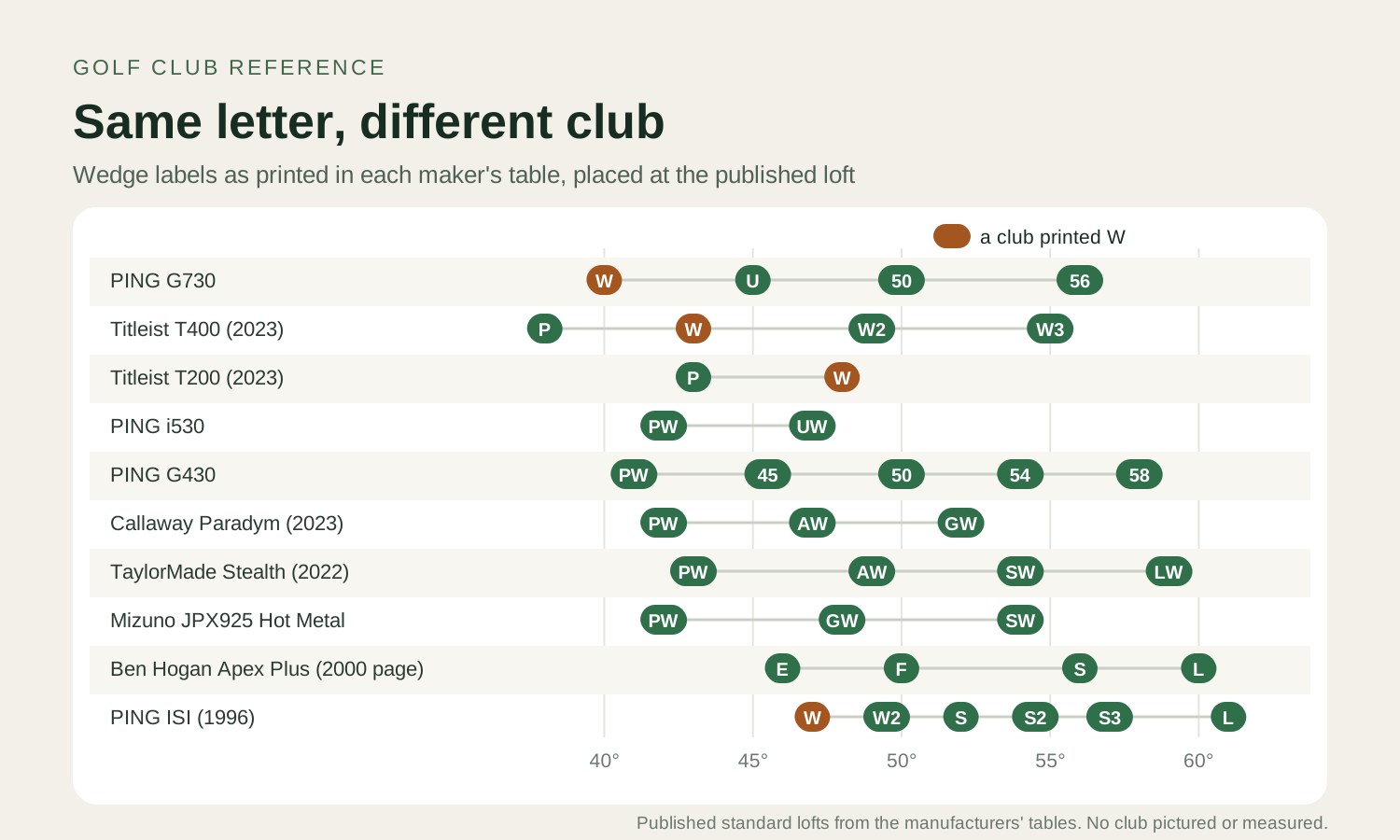
| Titleist | P, W, W2, W3 | T200 (2023): P 43°, W 48° |
| PING, most current sets | PW, UW, SW, LW | G425: PW 44.5°, UW 49.5°, SW 54°, LW 58° |
| PING G430 | PW, then 45, 50, 54, 58 | PW 41°, 45 at 45.5° |
| PING G730 | W, U, 50, 56 | W 40°, U 45° |
| Callaway | PW, AW, GW, SW, LW | Paradym (2023): PW 42°, AW 47°, GW 52° |
| TaylorMade | PW, AW, SW, LW | Stealth (2022): PW 43°, AW 49°, SW 54° |
| Srixon | PW, AW | ZX5: PW 44°, AW 50° |
| Mizuno | PW, GW, SW | JPX925 Hot Metal: PW 42°, GW 48°, SW 54° |
| Cobra | PW, GW | KING TEC (2025): PW 44°, GW 49° |
| Tour Edge | PW, AW, GW, SW | Exotics E725: AW 46°, GW 51° |
| Ben Hogan, 1998–2001 | E or EQ, F or FW, S or SI, L or LW | Apex Plus: E 46°, F 50°, S 56° |
Not every set in a brand uses every label in its row. TaylorMade and Callaway charts often stop at AW, and many players' sets stop at the pitching wedge. The iron loft finder shows the full spread of 7-iron and pitching wedge lofts across all the charts.
What W means: PING vs. Titleist
Two big brands use W for different clubs.
On a Titleist, W follows the P. The 2023 T200 lists P at 43° and W at 48°. The weakest-lofted model goes further: the T400 lists P at 38°, then W 43°, W2 49° and W3 55°. The labelling is old: the 2008 AP2 chart already printed a 47° P and a 51° W. Across the 28 Titleist charts with a W, it is 4° or 5° weaker than the P. Our article on 718 combo sets shows what happens to those gaps when sets are mixed.
On some PING sets, W is the pitching wedge. PING's current page for the G730 lists W at 40° after a 36° 9-iron, followed by U at 45°. Older PING classics do the same: the 1996 ISI and 1999 i3 charts print a 47° W. Most current PING pages, such as the i530, print PW instead.
So a single W sold on its own can be anything from a 40° pitching wedge to a 51° club below one. Identify the head first, then read that model's chart.
AW vs. GW, and Callaway's exception
In most sets AW and GW are the same club under two names: the wedge that fills the gap between the pitching wedge and a sand wedge. Brands pick one. TaylorMade and Srixon charts use AW; Mizuno, Cobra, Wilson and PXG use GW.
Callaway is the exception. Every Callaway chart we hold from before 2020 lists an AW and no GW. From the 2020 Mavrik on, 13 charts list both, as separate clubs. The 2023 Paradym runs PW 42°, AW 47° and GW 52°. On those sets the GW is weaker than the AW. An older Callaway AW, such as the 2015 Big Bertha's 49° club, sits in the same slot as a newer Callaway's AW, but a Callaway GW sits one club further down. Tour Edge's Exotics E725 also lists AW at 46° and GW at 51°.
So “AW and GW are the same thing” holds for most brands and fails for a recent Callaway set. Before adding a wedge, find the loft of the last club in your set; the wedge gap planner lays out the options below it.
PING's UW, U and numbered wedges
PING has used several systems. Most of its current and recent sets list PW, then UW: the G425 chart runs PW 44.5°, UW 49.5°, SW 54° and LW 58°. UW is usually read as utility wedge; PING's spec tables print the letters without spelling them out.
Two newer sets name their wedges differently. The G430 table lists PW at 41° and then wedges named by loft: 45, 50, 54 and 58 (the 45 is listed at 45.5°). The G730 uses W, U, 50 and 56, as above. Older PING sets have U as well: the i3 lists U at 52°, S at 56° and L at 60°.
On PING clubs the colored dot is a lie-angle code, not a wedge label. Our old PING irons by year article covers the dot and the classic sets.
Older letters: E, F, S, SI, L and LS
Older sets add letters that no current chart uses:
- E or EQ (Ben Hogan). Hogan called its pitching wedge the Equalizer. On the Apex Plus it is 46°; on the 1998 Apex blade, 48°.
- F or FW (Ben Hogan). The wedge below the Equalizer, 50° on the Apex Plus and 50° on the Apex Edge.
- S and SI. Hogan's 1998 Apex page names its 56° club the Sand Iron (SI). PING's ISI chart lists three S wedges: 52°, 54.5° and 57°, with a W2 at 49.5°.
- L and LS (PING). L is the highest-lofted wedge in the chart (61° on the ISI). The Zing 2 chart adds an LS at 57° between its 52° SW and 61° LW.
- Loft numbers (Cobra, 2004). The King Cobra SS Forged chart lists a P, then wedges labelled 50°, 55° and 60°.
If a head carries a letter you can't place, the model year finder narrows the set down by brand and name, and our guide to identifying older irons lists the other markings to read.
Reading a used set: 4–PW, 5–GW and P–W
Listings describe sets as ranges. 4–PW means the 4-iron through the pitching wedge, seven clubs. 5–GW starts at the 5-iron and ends at the gap wedge. On a Titleist the same kind of range ends at P or W, and on a G730 a 5–W set ends at the pitching wedge. Our guide to what an iron set includes covers these ranges in more detail.
- Read the model and generation on the head, then open that model's chart.
- Match each wedge letter to the chart, not to another brand's meaning.
- Check for a stamped loft. Separate wedges usually carry one; a 48° or 50° stamp on a different head is not part of the iron set.
- Have loft and lie checked if the gaps matter. Any used club may have been bent, and the wedge loft guide explains how to read the numbers you get.
Sources and limits
Counts and lofts come from the 198 iron records in our catalog, each transcribed from the manufacturer's own specification table or sheet, and are generated on this page from those records. Labels for the sets named here were checked against the sources below; the Titleist 2023 T-Series, Callaway Paradym and PING G430, G730 and i530 pages were reopened on October 11, 2026: Titleist T200 irons (2023), Titleist T400 irons (2023), Titleist AP2 irons (2008), PING G730 irons (2026 US page), PING G430 irons (2026 US page), PING G425 irons (2021 US page), PING i530 irons (2026 US page), PING ISI irons (1996), PING i3 Blade and O-Size irons (1999), PING Zing 2 irons (1994), Callaway Paradym irons (2023), Callaway MAVRIK irons (2020), Callaway Big Bertha irons (2015), TaylorMade Stealth irons (2022), Srixon ZX5 irons (original ZX), Mizuno Hot Metal irons (JPX925), Cobra KING TEC irons (2025), Cobra King Cobra SS Forged irons (2004 US page), Tour Edge Exotics E725 irons (2026 US page), Ben Hogan Apex Plus irons (2000 US page), Ben Hogan Apex Edge irons (2001), Ben Hogan Apex irons (1998).
The letters describe how each maker labels its own sets; they are not an industry standard, and a brand can change them. Our catalog covers the sets we have sourced, not every iron made, so a label missing here may still exist. Expansions such as approach wedge, gap wedge and utility wedge are common usage, not wording from the charts. No clubs were inspected, measured or hit for this article, and loft alone doesn't say how far a wedge carries or which one suits you.