
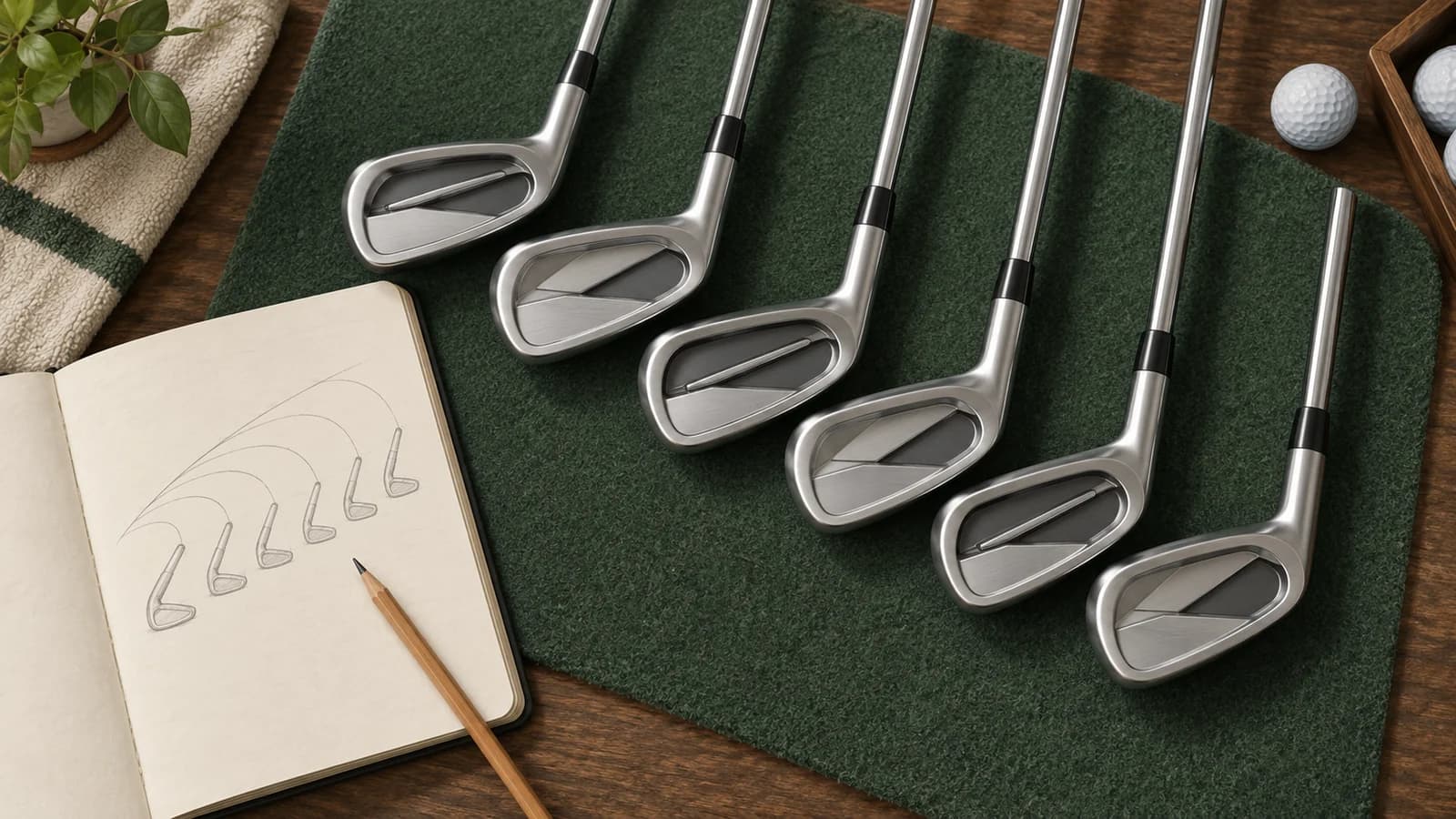
An example set with AP3 4–6 and AP2 7–PW has a 28° 6-iron followed by a 34° 7-iron at factory lofts. The subtraction gives 6°. That is a useful place to investigate when assessing the set's spacing. Carry distances still need to be checked with the actual clubs and golfer.
Start with two separate factory loft sequences
AP3 and AP2 are different heads within the 718 series. Titleist's 718 AP3 table and 718 AP2 table give each model its own loft row. The shared 718 label does not make those rows interchangeable.
| Club | 718 AP3 | 718 AP2 |
|---|---|---|
| 5-iron | 25° | 27° |
| 6-iron | 28° | 30° |
| 7-iron | 31° | 34° |
| 8-iron | 35° | 38° |
| Pitching wedge (P) | 43° | 46° |
For every published club, lie and length, open the individual 718 AP3 record and 718 AP2 record. These are original standard specifications. A custom order or later alteration can produce different measurements in a used set.
Calculate the step where the heads change
Subtract the loft of the last AP3 iron from the loft of the first AP2 iron. The examples below assume consecutive club numbers and unchanged factory lofts. They are calculations from the chart, rather than tested or recommended set configurations.
| Last AP3 iron | First AP2 iron | Loft step |
|---|---|---|
| 5-iron · 25° | 6-iron · 30° | 5° |
| 6-iron · 28° | 7-iron · 34° | 6° |
| 7-iron · 31° | 8-iron · 38° | 7° |
Moving the switch one club later also changes the calculation: AP3 7 to AP2 8 gives 7°. For comparison, keeping AP3 at both 6 and 7 gives 3°, while keeping AP2 at both numbers gives 4°. A uniform head sequence and a mixed one therefore need separate checks.
The direction matters, too. Replacing an AP3 6-iron with an AP2 6-iron while retaining an AP3 7-iron gives 30° followed by 31°, a 1° loft step. Check both neighboring clubs whenever a replacement changes the family. Our loft gap checker can calculate the sequence you enter; its output is an angle difference, not a prediction of yards.
Write down the model beside every club number
A listing described simply as “Titleist 718, 4–PW” leaves the changeover unclear. Ask for head photographs and record entries such as “6-iron: AP3 718” and “7-iron: AP2 718”. The identification checklistcovers the views to request when markings are hard to read.
Include the wedge model in that inventory. Titleist prints 43° for the AP3 P and 46° for the AP2 P. Selecting a pitching-wedge baseline therefore requires knowing which head finishes the mixed set. The set makeup guidehelps separate the clubs actually included from the manufacturer's full range.
Use measurements before deciding on a loft change
Keep three kinds of information in separate columns: the published factory loft, the current measured loft, and your observed carry distance. Ask the seller about previous bending, replacement shafts and length changes, and leave the measured column unknown until someone checks the clubs.
A clubmaker can establish the current angles and assess whether an adjustment is appropriate for those particular heads. A fitting or practice session can then check the carry spacing around the transition. The factory subtraction alone cannot establish a safe bending amount or the lofts that suit your swing.
For a used combo set, the most useful question is concrete: “What are the current lofts and carry distances of the two clubs on either side of the switch?” The chart tells you where to start checking; those measurements tell you what is in your bag.
Sources and calculation limits
Source tables reviewed October 1, 2026: Titleist's 718 AP3 specifications and 718 AP2 specifications. The selected factory values above match their US 718 loft rows. Titleist labels the pitching wedge P; our records display that row as PW. All loft steps in this article are our arithmetic from those values.
This is a specification-based check, with no hands-on testing, measured used clubs or bending prescription. It establishes neither fit nor a particular carry gap. The examples apply specifically to 718 AP3 and 718 AP2; other AP2 generations require their own source rows.