
The short answer
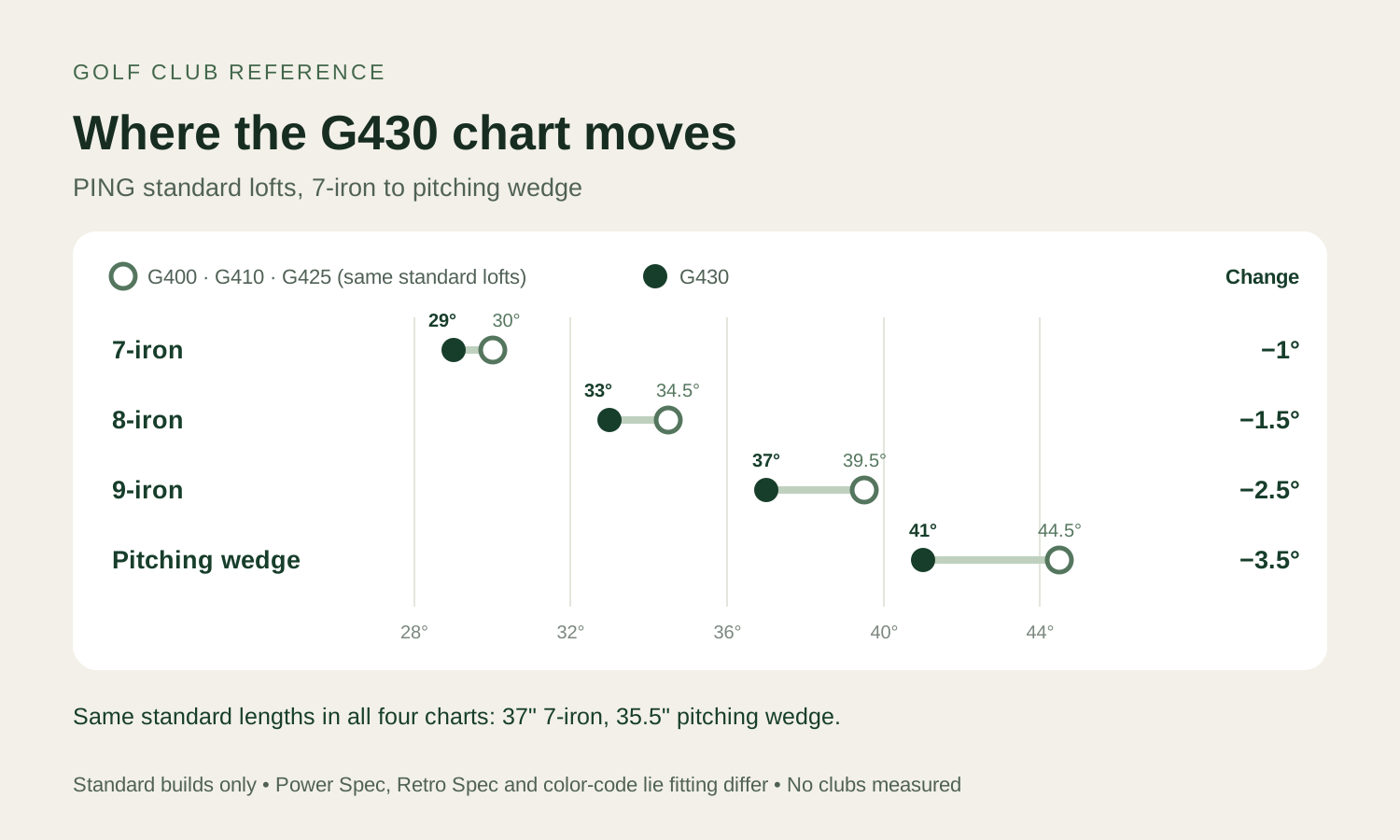
In PING's standard specifications, the G400 and G410 share every loft and length; G410 lists more upright 4-, 5- and 6-iron lies. The G425 publishes exactly the same loft, lie and length table as G410. The G430 is the chart that moves: stronger lofts from the 4-iron down, a 41° pitching wedge instead of 44.5°, and gap clubs labelled by loft.
Standard length did not change in any of the four tables. The 4-iron is 38⅞ inches, the 7-iron 37 inches and the pitching wedge 35½ inches throughout. If two used sets measure differently, the difference came from the build or a later alteration, not from the generation's standard chart.
Standard lofts side by side
Figures are degrees of loft from each model's PING US specification table. G400, G410 and G425 come from Internet Archive captures of PING's former product pages; G430 is from PING's current page. Each column describes the standard loft build only.
| Club | G400 | G410 | G425 | G430 |
|---|---|---|---|---|
| 4-iron | 20.5° | 20.5° | 20.5° | 19° |
| 5-iron | 23.5° | 23.5° | 23.5° | 22° |
| 6-iron | 26.5° | 26.5° | 26.5° | 25.5° |
| 7-iron | 30° | 30° | 30° | 29° |
| 8-iron | 34.5° | 34.5° | 34.5° | 33° |
| 9-iron | 39.5° | 39.5° | 39.5° | 37° |
| Pitching wedge | 44.5° | 44.5° | 44.5° | 41° |
The complete rows, including lie, length and the published wedges, are on each model page. Our iron comparison tool puts any two complete charts next to each other.
G400 to G410: the same lofts, different long-iron lies
A G400 and a G410 7-iron share 30° loft, 62° lie and 37 inches in the standard tables. The difference is at the long end. The G410 standard lies are more upright in the three longest irons:
| Club | G400 | G410 | G425 | G430 |
|---|---|---|---|---|
| 4-iron | 59.2° | 60.5° | 60.5° | 60.5° |
| 5-iron | 60.1° | 61° | 61° | 61° |
| 6-iron | 61.1° | 61.5° | 61.5° | 61.5° |
| 7-iron | 62° | 62° | 62° | 62° |
From the 7-iron down, all four charts list the same standard lies. So a lie difference between a used G400 4-iron and a G410 4-iron may simply reflect the factory chart. It does not, by itself, mean either club was bent. Read the lie figure together with the color code described below before drawing that conclusion.
On the head, look for an orange G400 badge beside a dark cavity insert with a circular element. The G410 has a red G410 badge on a black cavity insert, with PING above it.
G410 and G425: one chart, two different heads
This is the comparison where numbers stop helping. PING's archived G410 and G425 pages publish the same standard loft, lie and length for every listed club, from the 4-iron through the 58° lob wedge. A listing that only gives “30° 7-iron, 37 inches” fits both.
Identify these two from the heads. The G425 has a G425 marking beside a large PING wordmark running across the dark cavity panel; the G410 has its red G410 badge. Ask a seller for a clear photograph of the back of every head, including the wedges, because mixed sets are possible on the used market. Shaft and grip labels can support an identification but may have been replaced. Srixon did the same thing across five generations of its 5-numbered irons; our Srixon Z 585 vs. ZX5 comparison lists the badge cues for each.
Matching standard charts also say nothing about how the clubs perform against each other. They are different head designs, and no published loft table settles how either one launches, sounds or forgives for a particular golfer.
G430: stronger lofts and renamed wedges
The G430 standard 7-iron is 29°, one degree stronger than the previous three charts. The gap widens toward the short irons: the 8-iron moves 1.5°, the 9-iron 2.5° and the pitching wedge 3.5°, from 44.5° to 41°. The 4-, 5- and 6-iron move between 1° and 1.5°.
That changes the wedge rows as well. The G400, G410 and G425 charts continue after the 44.5° pitching wedge with a 49.5° UW, a 54° SW and a 58° LW. The G430 page instead labels the clubs after its 41° pitching wedge by loft: 45°, 50°, 54° and 58°, with a published loft of 45.5° for the 45° club. In practice, the G430's 45° club sits next to where the older pitching wedge was.
Two practical consequences for used buyers. First, a G430 set “through PW” ends about 3.5° stronger than a G425 set through PW, so compare the full loft list rather than the club count. Second, if you mix generations, for example G425 irons with G430 gap clubs, check the actual loft of each club next to its neighbors. The loft gap checkershows the steps; it cannot tell you your carry gaps, which only measured shots can.
You may also see a G430 HL. PING's separate HL page publishes the identical loft, lie and length table; it is a lighter stock shaft and grip package for the same head, rather than a different iron model.
Power Spec and Retro Spec overlap the standard charts
PING also lists alternative factory loft builds, so a used set may not match the standard column at all. According to the same source pages, the 7-iron is 28.5° in Power Spec for G400, G410 and G425. G425 also lists a 32.3° Retro Spec 7-iron. G430 lists a 27.5° Power Spec and a 31° Retro Spec 7-iron.
The overlap is the important part. A Power Spec G425 7-iron (28.5°) is stronger than a standard G430 7-iron (29°), and a Retro Spec G430 7-iron (31°) is weaker than a standard G410 (30°). A measured loft therefore cannot identify the generation, and a generation name cannot confirm the loft build. Identify the head first, then ask whether the set was ordered in standard, Power Spec or Retro Spec, and treat the answer as unconfirmed unless the original order or a loft measurement supports it.
The color dot changes the lie
The lie angles above are PING's standard specification. PING fits lie angle with a color-coded dot, so a fitted set may have been built flatter or more upright than this chart. On a used PING iron, note the dot color and check it against PING's current color code chart before assuming the standard lie.
Even then, the dot records how the set was built, not its present condition. Irons can be bent after leaving the factory. If lie matters to your decision, have it measured on a loft and lie machine. Our lie angle guide explains why the right lie depends on the golfer as well as the club.
Checking a used G-series set
- Read the head. Photograph the back of each club and match the badge to G400, G410, G425 or G430. Do not identify the set from lofts or the box.
- List the clubs actually included. Record each club label. On G430, a club marked by loft is not the same as an older UW or SW with the same name.
- Ask about the loft build. Standard, Power Spec and Retro Spec overlap between generations, so the build needs its own answer.
- Record the color dot. Compare it with PING's chart and keep it separate from any measured lie.
- Measure length and check alterations. All four standard charts share the same lengths, so a different measured length points to a custom build or a modification. Our used-iron checklist covers what else to inspect.
The same order works for older PING sets in our catalog: identify the exact head, choose the matching standard row, and treat every figure as the original factory build until the clubs themselves are checked. Start from PING's iron charts, our guide to classic PING irons by year or our photo identification checklist.
Sources and limits
Figures come from our catalog records of PING's US specification tables, retrieved October 7, 2026: the G400 page, G410 page and G425 page as captured by the Internet Archive, and PING's current G430 page. PING lists lengths in fractional inches; the catalog stores them as decimals. The capture dates are page dates, not release years or the manufacture date of any individual club, so this article does not assign release years.
This comparison transcribes selected factual values rather than reproducing PING's charts. We tested and measured no clubs. Published lofts do not predict carry distance, launch or fit, and a used club may have been bent, reshafted, shortened or otherwise modified since it was built.