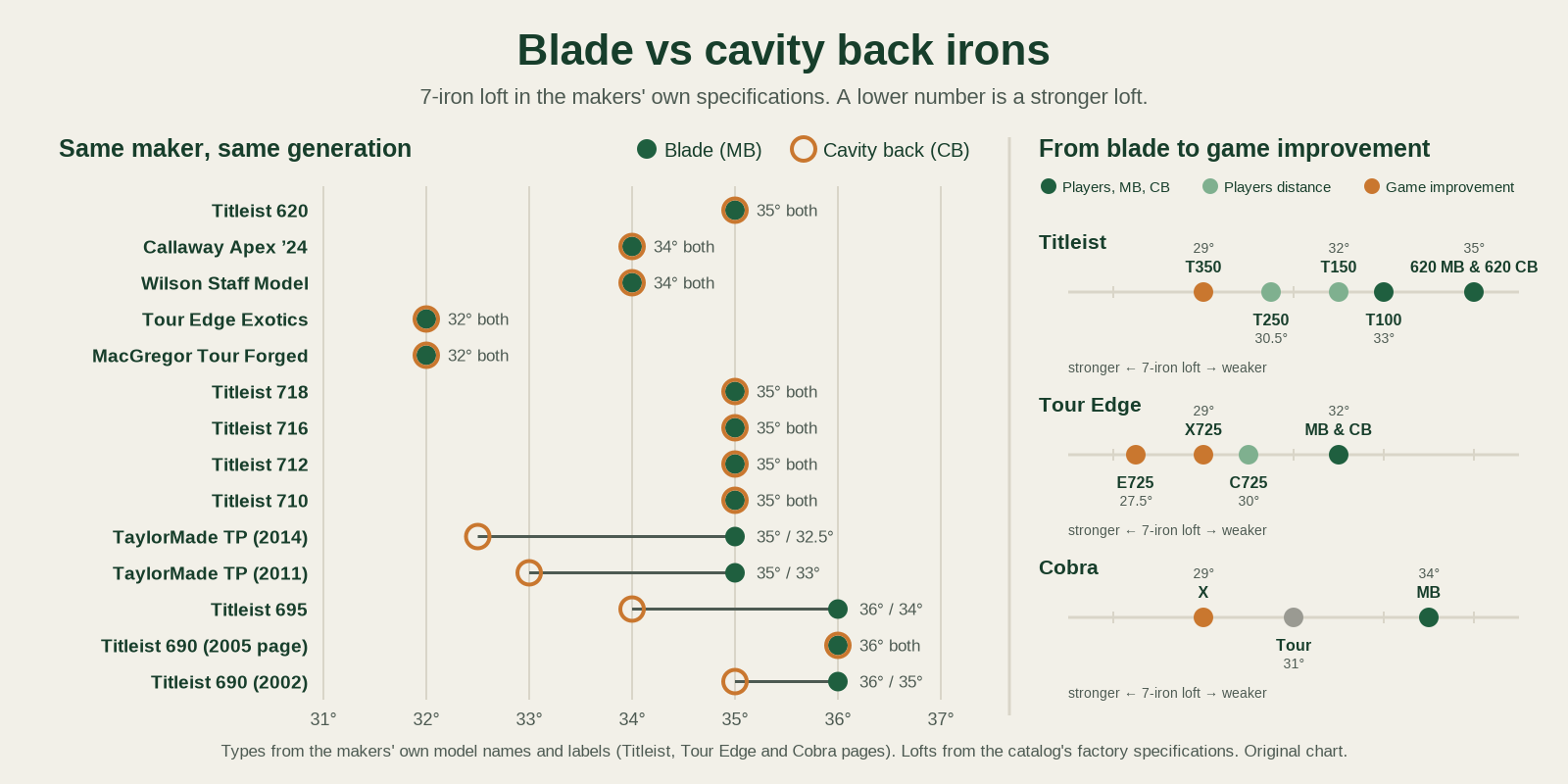
A blade and a cavity back from the same maker usually have the same lofts. In the 14 maker listings in our catalog that show both types from one generation, the 7-iron loft is the same in 10, and in those 10 every other loft, lie and length matches too. What differs is the head behind the face. Loft moves further down a maker's range: from its blade to its own game-improvement irons, the 7-iron gets 4.5° to 6° stronger in the three ranges below.
What blade and cavity back mean
The names describe the back of the head. A blade, also sold as a muscle back or MB, has a solid back behind the hitting area. A cavity back, or CB, has a hollowed-out back. Makers describe the trade-off in similar terms. Tour Edge calls its Exotics MB a "modern muscle-back" with "elite workability", and says its Exotics CB gives "enhanced forgiveness on off-center strikes". MacGregor's Tour Forged CB, by its own description, "offers golfers more forgiveness on shots that aren't out the center".
Some makers sell a step between the two. TaylorMade's Tour Preferred range had an MB, an MC and a CB. Its 2014 sheets call the MB a blade iron and describe the MC as a "precision-engineered cavity design", and the MC's 7-iron sits between the other two: 35° for the MB, 34° for the MC and 33° for the CB in 2011, and 32.5° for the CB in 2014. Hollow-body and "players distance" irons are separate types again, covered further down.
Blade vs cavity back lofts: the same in most pairs
These are all the listings in our catalog where a maker published a blade and a cavity back from the same generation, by the type in the maker's own model name. They cover 13 generations, because Titleist listed its 690 pair twice.
| Maker and listing | Blade | Cavity back | Lofts |
|---|---|---|---|
| Titleist 620 (2026 US pages) | 620 MB: 35° / 47° | 620 CB: 35° / 47° | Same in every club |
| Callaway Apex ’24 | Apex MB 24: 34° / 46° | Apex CB 24: 34° / 46° | Same in every club |
| Wilson Staff Model (2026 US pages) | Staff Model Blade: 34° / 46° | Staff Model CB: 34° / 46° | Same in every club |
| Tour Edge Exotics (2026 US pages) | Exotics MB: 32° / 46° | Exotics CB: 32° / 46° | Same in every club |
| MacGregor Toney Penna Tour Forged (2026 US pages) | Toney Penna Tour Forged MB: 32° / 45° | Toney Penna Tour Forged CB: 32° / 45° | Same in every club |
| Titleist 718 | MB: 35° / 47° | CB: 35° / 47° | Same in every club |
| Titleist 716 | MB: 35° / 47° | CB: 35° / 47° | Same in every club |
| Titleist 712 | MB: 35° / 47° | CB: 35° / 47° | Same in every club |
| Titleist 710 | MB: 35° / 47° | CB: 35° / 47° | Same in every club |
| TaylorMade Tour Preferred (2014 sheets) | Tour Preferred MB: 35° / 47° | Tour Preferred CB: 32.5° / 46° | CB up to 3° stronger |
| TaylorMade Tour Preferred (2011 sheets) | Tour Preferred MB: 35° / 47° | Tour Preferred CB: 33° / 46° | CB up to 2° stronger |
| Titleist Forged 695 (2006 pages) | Forged 695MB: 36° / 48° | Forged 695CB: 34° / 46° | CB up to 2° stronger |
| Titleist Forged 690 (2005 pages) | Forged 690.MB: 36° / 48° | Forged 690.CB: 36° / 48° | Same in every club |
| Titleist 690 (2002 listing) | 690MB Forged Muscle Back: 36° / 48° | 690CB Forged: 35° / 47° | CB up to 1° stronger |
In 10 of the 14 listings, the blade and the cavity back have the same loft, lie and length at every club the two tables list. In the other 4, the cavity back has the stronger lofts, by 1° to 2.5° at the 7-iron: Titleist's 2002 listing of the 690 and its 695, and TaylorMade's Tour Preferred sheets from 2011 and 2014. No listing has a cavity back weaker than its blade. Titleist's later listing of the 690, on its 2005 page, gives the cavity back the blade's lofts.
The lies match in all 14 listings. Only one pair differs in length, and only at one club: TaylorMade's 2014 MB sheet prints the 8-iron at 35.25 in, while the CB sheet gives 36.25 in. The MB figure is a full inch below the half-inch steps of its other irons and looks like a misprint; the record shows it as printed.
What changes instead: Callaway's own comparison
Callaway's product pages compare its 2024 Apex MB and Apex CB side by side. Both have a 34° 7-iron.
| Callaway's chart | Apex MB ’24 (blade) | Apex CB ’24 (cavity back) |
|---|---|---|
| Offset | Least | Less |
| Topline | Thinnest | Thinnest |
| Sole width | Thinnest | Thinner |
| Head shape | Compact | Compact |
| Launch | Low | Low-mid |
| Workability | High | Mid-high |
| Forgiveness | Low | Low-mid |
| 7-iron loft | 34° | 34° |
By Callaway's own ratings, the cavity back has more offset and a wider sole, launches higher and is more forgiving, and the blade is more workable. Both are rated compact, with the thinnest topline. Tour Edge and MacGregor describe the same trade-off on their pages, and none of it shows up in the loft column.
Where the big loft gap is: players irons to game improvement
The large loft differences sit between a maker's players irons and its distance and game-improvement models. Three makers label each model's type on their own pages.
| Model | Titleist's type | 7-iron | PW |
|---|---|---|---|
| 620 MB | Player's | 35° | 47° |
| 620 CB | Player's | 35° | 47° |
| T100 | Player's | 33° | 45° |
| T150 | Player's Distance | 32° | 44° |
| T250 | Player's Distance | 30.5° | 43° |
| T350 | Game Improvement | 29° | 43° |
Titleist's selector calls the 620 MB, the 620 CB and the T100 "Player's", the T150 and T250 "Player's Distance" and the T350 "Game Improvement". The 7-iron goes from 35° in the 620s to 29° in the T350, a 6° spread.
| Model | Tour Edge's type | 7-iron | PW |
|---|---|---|---|
| Exotics MB | Muscle-back | 32° | 46° |
| Exotics CB | Cavity-back | 32° | 46° |
| Exotics C725 | Players Distance Iron | 30° | 44° |
| Exotics X725 | Super Game Improvement Iron | 29° | 43.5° |
| Exotics E725 | Game Improvement Iron | 27.5° | 42° |
Tour Edge's MB and CB share a 32° 7-iron. Its comparison chart for the 725 irons labels the C725 "Players Distance", the E725 "Game Improvement" and the X725 "Super Game Improvement". The super game improvement model is not the strongest: the X725's 7-iron is 29° and the E725's 27.5°, so the label alone does not tell you the loft.
| Model | Cobra's type | 7-iron | PW |
|---|---|---|---|
| 3DP MB | Blade | 34° | 46° |
| 3DP Tour | Not stated | 31° | 45° |
| 3DP X | Super-game improvement | 29° | 43° |
Cobra describes its 3DP MB as having the look and feel of a "traditional forged blade", and its 3DP X as "super-game improvement performance" in a more compact shape. Their 7-irons are 34° and 29°, a 5° spread, with the 3DP Tour in between at 31°.
Blades and cavity backs on sale in 2025–26
Our 7-iron loft study counts 66 iron sets on sale in 2025 and 2026. 10 of them carry MB, Blade or CB in the model name.
| Set | Type | 7-iron | PW | 7-iron length |
|---|---|---|---|---|
| Titleist 620 MB | Blade | 35° | 47° | 37 in |
| Titleist 620 CB | Cavity back | 35° | 47° | 37 in |
| Cobra 3DP MB | Blade | 34° | 46° | 37.25 in |
| Wilson Staff Model Blade | Blade | 34° | 46° | 37.25 in |
| Wilson Staff Model CB | Cavity back | 34° | 46° | 37.25 in |
| PXG 0317 CB | Cavity back | 33° | 46° | 37 in |
| MacGregor Toney Penna Tour Forged MB | Blade | 32° | 45° | 37 in |
| Tour Edge Exotics MB | Blade | 32° | 46° | 37 in |
| MacGregor Toney Penna Tour Forged CB | Cavity back | 32° | 45° | 37 in |
| Tour Edge Exotics CB | Cavity back | 32° | 46° | 37 in |
Their 7-irons run from 32° to 35°. The median 7-iron of all 66 sets is 30.75°, and the strongest is 27°. The two weakest 7-irons on sale are the Titleist 620 MB and 620 CB, at 35°.
How to tell which one you have
- Read the head and the model name. MB, CB, MC, Blade and Muscle Back are part of the model names above, and a cavity back shows its recessed back when you turn the club over.
- Look up the factory lofts. Find the model in the iron loft finder, or put two sets side by side in the iron comparison tool.
- Do not judge the type by the loft. The Tour Edge Exotics MB and the Titleist T150, a "Player's Distance" iron, both have a 32° 7-iron.
Which type fits your game
The makers say who each model is for in their own words. Titleist says the 620 MB is for "the golfing purist", the T150 is "especially preferred by low-to-mid handicap golfers", the T250 caters "to mid-handicap golfers", and the T350 is for "players who want maximum distance and forgiveness". Those are the makers' descriptions, not a fitting. Loft alone does not set how far an iron goes or whether it suits you, and a fitting with your own swing is the way to settle it. The golf club loft chart shows the usual loft of every club, and the iron set guide explains what a set includes.
Sources and limits
Lofts, lies and lengths are the factory specifications in our catalog, each with its maker source on the model page. A model's type comes from the maker's own model name or from the label on the maker's page. Titleist's labels and audience lines are from its 620 MB, 620 CB, T100, T150, T250 and T350 pages, read in Internet Archive captures from May 9 to August 9, 2026. Tour Edge's from its Exotics MB, CB, C725, E725 and X725 pages, read October 8, 2026. Cobra's from its 3DP MB and 3DP X pages, captured January 16, 2026. Callaway's comparison from its Apex MB ’24 and Apex CB ’24 pages, captured June 18, 2026 and February 8, 2026. MacGregor's from its Tour Forged CB page, read November 21, 2026. TaylorMade's from its 2014 Tour Preferred MB and MC spec sheets in its product-specs archive. We did not sort any iron into a type ourselves, and a model whose maker gives no type is left blank. Reviewed November 21, 2026. A used club may have been bent or reshafted, so its lofts can differ from the factory figures.