A golf shaft flex chart matches a swing speed to a flex. The five common flexes run from L (ladies) through A (senior), R (regular) and S (stiff) to X (extra stiff); in PXG's words, "the faster the swing, the stiffer the shaft required." Makers agree on that order, but their speeds differ. On the six makers' charts below, stiff begins at 85 mph on Mitsubishi Chemical's TENSEI chart, at 95 mph on Callaway's and PXG's, and only above 105 mph on Honma's.
Each chart is a maker's starting point for a fitting, and this page is not a fitting. Mitsubishi's own sheet calls its chart "general guidelines for professional fitters".
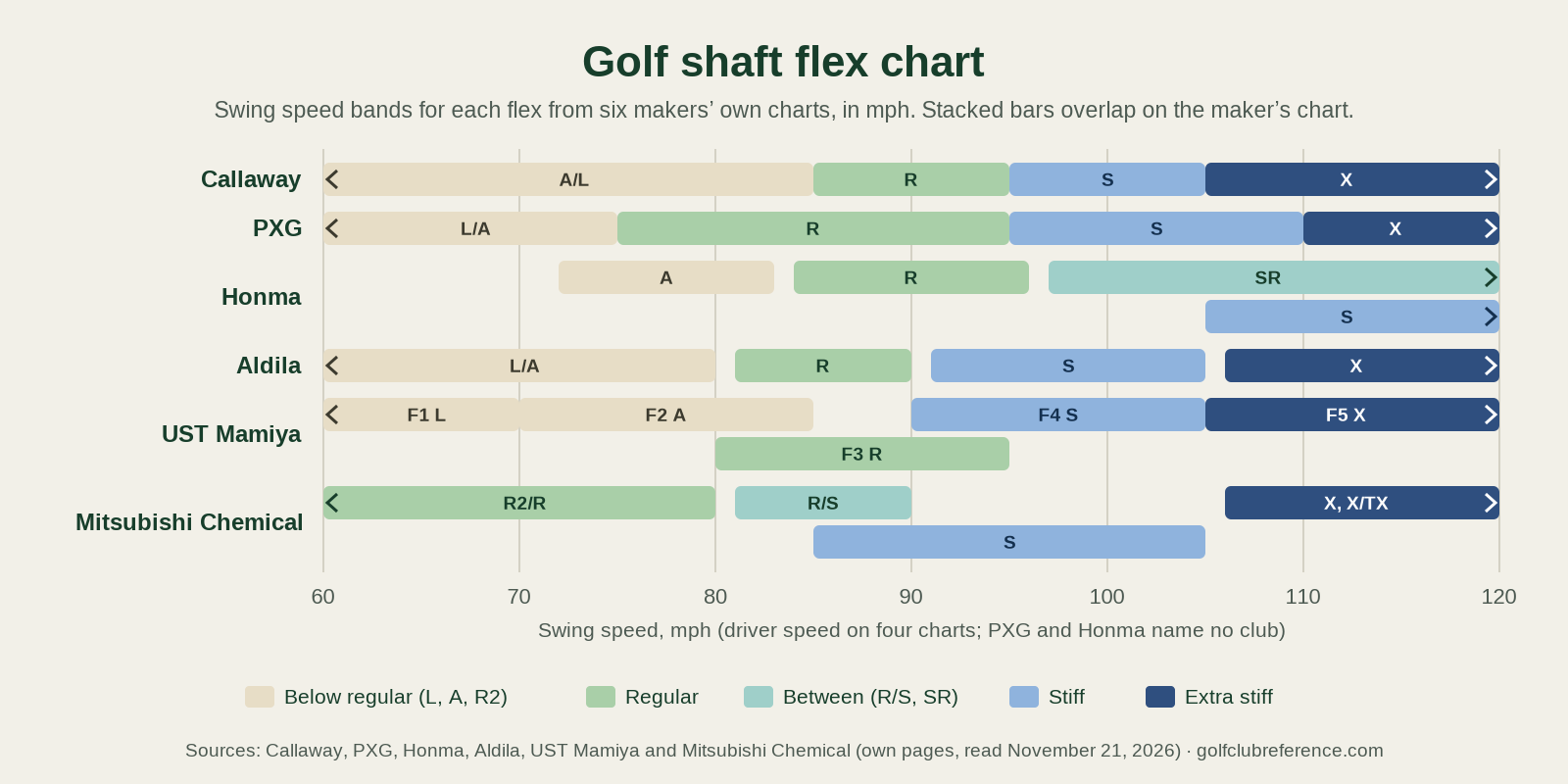
Golf shaft flex chart: six makers side by side
Each row is one maker's chart as published, with speeds in miles per hour. Callaway, PXG and Honma make clubs; Aldila, UST Mamiya and Mitsubishi Chemical make shafts and publish a chart for each shaft model, so their rows show one model each.
| Maker and chart | Below regular | Regular (R) | Stiff (S) | Extra stiff (X) | Speed of | Read |
|---|---|---|---|---|---|---|
| Callaway, driver shaft chart | below 85 (A/L) | 85–95 | 95–105 | 105+ | Driver | Nov 21, 2026 |
| PXG, swing speed and flex table | below 75 (L/A) | 75–95 | 95–110 | over 110 | Not named | Nov 21, 2026 |
| Honma, shaft flex list | 72–83 (A); L: female players, generally above 42; R2: soft regular, no speed given | 84–96 | over 97 (SR); over 105 | Not listed | Not named | Nov 21, 2026 |
| Aldila, NV Green and Pink fit guide | below 80 (L/A, 55 g) | 81–90 | 91–105 | 106+ (65 and 75 g) | Driver | Nov 21, 2026 |
| UST Mamiya, Recoil DART hybrid shaft chart | below 70 (F1, L); 70–85 (F2, A) | 80–95 (F3) | 90–105 (F4) | over 105 (F5) | Driver | Nov 21, 2026 |
| Mitsubishi Chemical, TENSEI 1K Blue (2026) fit guide | Not listed | below 80 (R2/R, 55 g); 81–90 (R/S, 55 and 65 g) | 81–90 (R/S, 55 and 65 g); 85–105 | over 106 (55 g); over 106 (X/TX, 65 and 75 g) | Driver | Nov 21, 2026 |
Four charts name the driver: Callaway's, Aldila's, UST Mamiya's and Mitsubishi Chemical's. PXG and Honma give miles per hour without naming a club. UST writes its chart in driver swing speed even on its iron shaft pages. Callaway publishes a separate chart for irons with slower speeds: ladies below 60, light 60–70, R 70–80, S 80–90 and X 90–100 mph.
What the charts say at the same speed
Read across a row to see where one swing speed lands on each chart. Where two bands of a chart overlap or share an end point, both flexes are shown.
| Swing speed | Callaway | PXG | Honma | Aldila | UST Mamiya | Mitsubishi Chemical |
|---|---|---|---|---|---|---|
| 75 mph | A/L | R | A | L/A | F2 (A) | R2/R |
| 85 mph | R | R | R | R | F2 (A) or F3 (R) | R/S or S |
| 90 mph | R | R | R | R | F3 (R) or F4 (S) | R/S or S |
| 95 mph | R or S | R or S | R | S | F3 (R) or F4 (S) | S |
| 100 mph | S | S | SR | S | F4 (S) | S |
| 105 mph | S or X | S | SR | S | F4 (S) | S |
| 110 mph | X | S | SR or S | X | F5 (X) | X or X/TX |
At 100 mph, five of the six charts list stiff and nothing else, and Honma's lists SR. At 90 mph they split: Callaway's, PXG's, Honma's and Aldila's charts say regular, UST's falls where its F3 and F4 bands overlap, and Mitsubishi's lists R/S or S.
Regular vs stiff: where the charts switch
The charts differ most on where stiff begins: at 85 mph on Mitsubishi Chemical's TENSEI 1K Blue chart, 90 on UST Mamiya's, 91 on Aldila's, 95 on Callaway's and PXG's, and only above 105 on Honma's. That is a 20 mph spread for the same letter.
Three charts add an in-between step. Mitsubishi lists R/S from 81 to 90 mph, UST's F3 and F4 bands overlap from 90 to 95 mph, and Honma puts SR, its stiff regular, above 97 mph. The charts also differ on X: five list it, from 105 mph and up on Callaway's chart to above 110 on PXG's, and Honma's lists no X.
A swing in the low 90s can therefore be regular on one maker's chart and stiff on another's. Callaway adds that "flex and weight should align with your swing speed and tempo", and PXG's fitters track tempo, ball speed and spin as well as speed.
What the flex letters mean
PXG spells out the five letters: L for ladies, A for senior, R for regular, S for stiff and X for extra stiff. A stands for senior because, PXG says, the flex was originally called "amateur". Callaway's driver chart joins the two softest flexes in one A/L band, and UST Mamiya numbers its flexes F1 to F5.
PXG also notes that two shafts with the same flex can have different bend profiles, and Mitsubishi Chemical's flex guide rates the butt, middle and tip of each shaft separately. An R from one maker does not have to bend like an R from another.
The spec sheets in our catalog print more than five labels:
| Label | Records | Brands | What it means |
|---|---|---|---|
| R2 | 8 | Callaway, XXIO | Honma calls R2 a soft regular, the flex closest to senior in its BERES clubs. Callaway and XXIO print it without a definition. |
| SR | 2 | XXIO | Honma: stiff regular, for players above 97 mph. XXIO's sheets list it after R. |
| Soft Regular | 8 | PING | PING's sheets spell it out and list it before Regular; they give no speed for it. |
| LR | 1 | XXIO | A custom flex on the Speeder NX shaft of the XXIO 14 Ladies irons; the sheet does not define it. |
| Lite, Ultra Lite | 5 | Cobra, PING | Cobra's AIR-X sheets list S, R and Lite; PING's G Le4 irons list Ultra Lite and Lite. Neither sheet defines them. |
| 5.0, 5.5, 6.0, 6.5 | 7 | PING, Srixon | Project X's numbered flexes. The Srixon ZXi MAX driver sheet pairs 5.0 with A, 5.5 with R and 6.0 with S. |
| F2, F3, F4 | 2 | Cobra, PING | UST Mamiya's codes. UST's own tables pair them with letters: F1 L, F2 A, F3 R, F4 S, F5 X. The PING G740 iron sheet prints 65A (F2), 75R (F3) and 75S (F4). |
| 35, 45, ALTA Quick 35, ALTA Quick 45 | 9 | PING | PING lists its ALTA Quick shaft as 35 and 45 where other shafts have a letter. |
| R300, S300, X100 | 2 | PING | On PING's G440 and G740 iron sheets, next to the spelled-out flexes; both list True Temper Dynamic Gold shafts. |
Labels also change over time. TaylorMade's sheet for the 2016 M2 irons lists the graphite shafts as S-75, R-65, M-55 and L-45; the sheet for the 2017 M2 irons lists S-75g, R-65g, A-55g and L-45g. Where the older sheet prints M, the newer one prints A.
Which flexes clubs come in
133 records from 10 brands in our catalog give their flexes in a field of their own. The table counts a letter or the same flex spelled out, such as Regular for R or Senior for A.
| Club type | Records with flexes | L (Ladies) | A (Senior) | R (Regular) | S (Stiff) | X (Extra stiff) |
|---|---|---|---|---|---|---|
| Drivers | 41 | 3 | 22 | 40 | 36 | 24 |
| Fairway woods | 29 | 3 | 12 | 23 | 23 | 14 |
| Hybrids | 27 | 4 | 10 | 25 | 20 | 8 |
| Iron sets | 24 | 6 | 12 | 18 | 17 | 5 |
| Complete sets | 10 | 3 | 2 | 6 | 0 | 0 |
| Wedges | 2 | 0 | 0 | 0 | 2 | 0 |
R is listed on 40 of the 41 drivers and S on 36. X appears on 24 drivers and A on 22, while only 3 list L. X thins out on shorter clubs: 8 of 27 hybrids and 5 of 24 irons list it.
The choice can depend on the head. Cobra's DARKSPEED MAX driver lists S and R for its 9.0° head, S, R and A for the 10.5° head and R and A for the 12.0° head. Some models come in one flex only: Callaway's Quantum Max Fast irons list R2 and nothing else.
How to find the flex of your shaft
- Read the shaft. The flex is usually printed on the shaft's label as a letter, a number such as 5.5 or 6.0, or a code such as F3.
- Compare it with the model's stock flexes. Each model page lists the flexes its maker published, with the source; browse the driver records or search for your model. On a used set, check that the shafts and flex labels match through the set, as our used iron checklist suggests.
- Know which speed a chart means before you read it. Most charts here use driver speed. Our swing speed calculator page explains how to measure club speed with a launch monitor or a radar.
- Read more than one chart, then let a fitting decide. Each chart is written for its maker's own shafts.
Sources and limits
The speed bands come from each maker's own page, read on November 21, 2026: Callaway's driver and iron FAQs, PXG's custom shaft FAQ, Honma's US FAQ, Aldila's NV Green fit guide, UST Mamiya's Recoil DART hybrid shaft page and Mitsubishi Chemical's TENSEI 1K Blue 2026 sell sheet. Each row in the first table links its source. Carry-distance columns that some charts add are left out, and shaft makers publish other bands for other models. The catalog counts come from the 133 records whose spec sheets give flexes in a field of their own; flexes that appear only in a shaft name or a note, as on most iron sheets, are not counted, and labels are counted as printed. Nothing here recommends a flex for you or says how a flex changes your shots: the charts are the makers' starting points, and a fitter with a launch monitor measures more than speed.