Bounce is the angle between a wedge's leading edge and the lowest point of its sole, and the more bounce a wedge has, the higher the leading edge sits off the ground at address, as Titleist's Vokey guide puts it. In the 567 loft and bounce options that 47 wedge lines from 8 brands publish, the median 56° sand wedge has 12° of bounce and the median 58° and 60° wedges 10°. Gap wedges at 50° and 52° sit at 10°, and lob wedges offer the widest choice, from 4° to 15° at 60°.
Titleist groups bounce into three bands: low bounce is typically 4° to 6°, mid bounce about 7° to 10°, and high bounce more than 10°. The tables below use those bands. They are factory specifications from each maker's sheets, not measurements of real clubs.
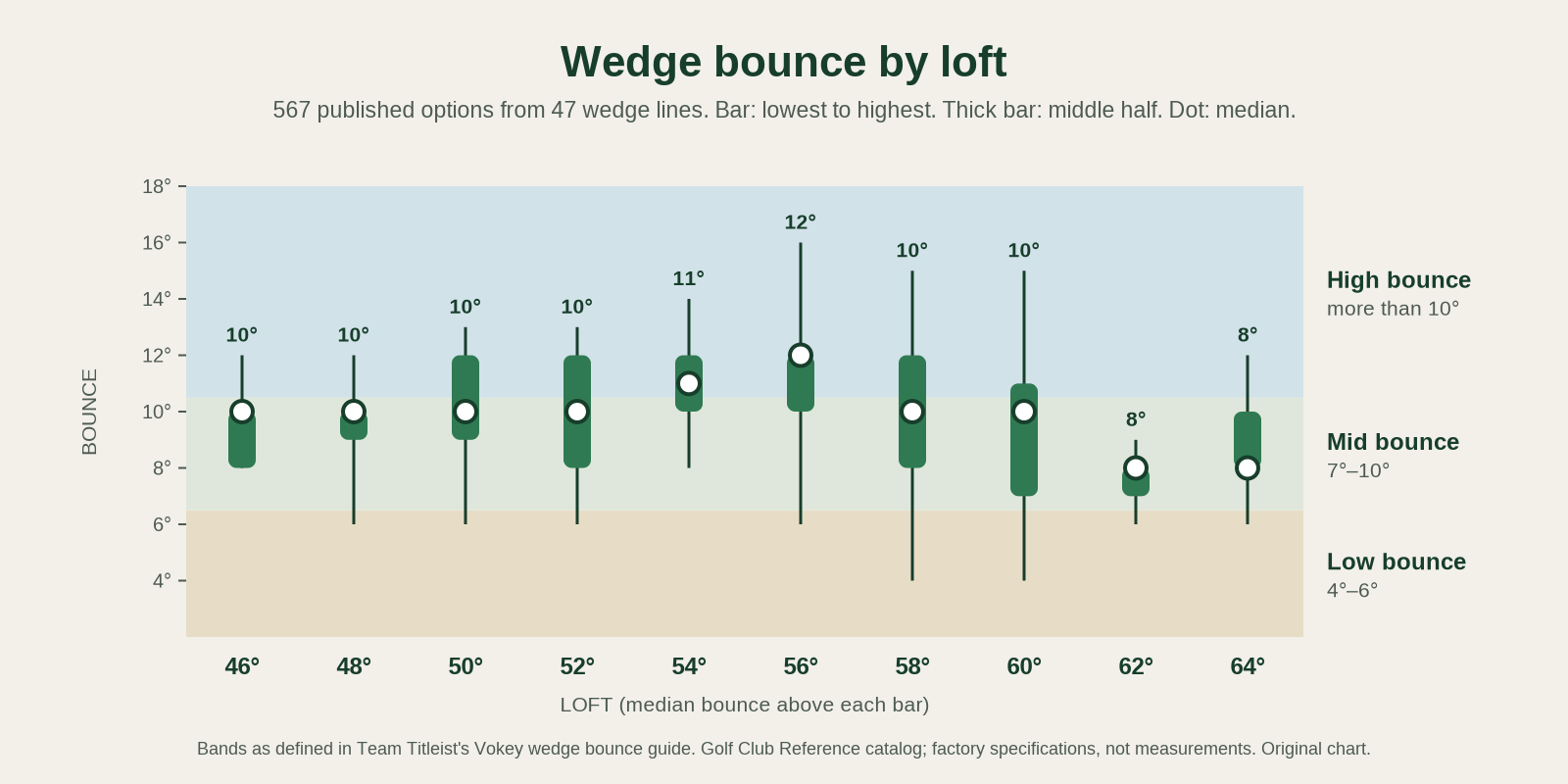
Wedge bounce chart by loft
Each row counts the bounce options at one loft: one wedge line offering one bounce, however many grinds or hands it comes in. Lofts with fewer than 10 options are left out.
| Loft | Median bounce | Middle half of options | Lowest to highest | Most common | Options (lines) |
|---|---|---|---|---|---|
| 46° | 10° | 8°–10° | 8°–12° | 10° (9) | 17 (17) |
| 48° | 10° | 9°–10° | 6°–12° | 10° (15) | 24 (23) |
| 50° | 10° | 9°–12° | 6°–13° | 12° (14) | 47 (36) |
| 52° | 10° | 8°–12° | 6°–13° | 10° (16) | 56 (44) |
| 54° | 11° | 10°–12° | 8°–14° | 10° (25) | 82 (43) |
| 56° | 12° | 10°–12° | 6°–16° | 12° (27) | 93 (46) |
| 58° | 10° | 8°–12° | 4°–15° | 12° (25) | 110 (45) |
| 60° | 10° | 7°–11° | 4°–15° | 10° (29) | 113 (47) |
| 62° | 8° | 7°–8° | 6°–9° | 8° (6) | 11 (11) |
| 64° | 8° | 8°–10° | 6°–12° | 8° (4) | 11 (11) |
Sand wedges carry the most bounce: at 56° the middle half of the options is 10°–12°, and the highest bounce in the table, 16°, is on a 56°. At 58° and 60° the median drops to 10°, but the middle half widens to 8°–12° at 58° and 7°–11° at 60°: lob wedges come both with very low bounce and with high bounce.
Low, mid and high bounce
Titleist recommends low bounce for firm turf and bunkers with firm or coarse sand, mid bounce for firm to normal turf as the most versatile choice, and high bounce for soft turf, fluffy lies and soft sand. It adds that a high-bounce lob wedge suits golfers with a steep swing who take deep divots. This is how the options at each loft fall into those bands:
| Loft | Low (6° or less) | Mid (7°–10°) | High (more than 10°) |
|---|---|---|---|
| 46° | 0% (0) | 94% (16) | 6% (1) |
| 48° | 8% (2) | 88% (21) | 4% (1) |
| 50° | 2% (1) | 62% (29) | 36% (17) |
| 52° | 2% (1) | 68% (38) | 30% (17) |
| 54° | 0% (0) | 49% (40) | 51% (42) |
| 56° | 2% (2) | 41% (38) | 57% (53) |
| 58° | 13% (14) | 53% (58) | 35% (38) |
| 60° | 18% (20) | 55% (62) | 27% (31) |
| 62° | 18% (2) | 82% (9) | 0% (0) |
| 64° | 9% (1) | 82% (9) | 9% (1) |
57% of the 56° options are high bounce, against 27% at 60°. Low bounce is mostly a lob wedge option: 20 of the 113 options at 60° and 14 at 58° are 6° or less, against 2 at 56°.
Sand wedge and lob wedge bounce by brand
Brands offer quite different spreads at the same loft. At 56°:
| Brand | Bounce options | Lowest to highest | Wedge lines |
|---|---|---|---|
| TaylorMade | 8°, 9°, 10°, 12°, 13°, 14°, 15°, 16° | 8°–16° | 13 lines |
| Callaway | 8°, 10°, 11°, 12°, 13°, 14° | 8°–14° | 10 lines |
| Titleist | 8°, 10°, 11°, 12°, 14° | 8°–14° | 8 lines |
| Cleveland | 8°, 10°, 12°, 14° | 8°–14° | 5 lines |
| Tour Edge | 6°, 8°, 10°, 12°, 13°, 14° | 6°–14° | 5 lines |
| Cobra | 7°, 10°, 12°, 14° | 7°–14° | 2 lines |
| Mizuno | 6°, 8°, 10°, 12° | 6°–12° | 2 lines |
| PXG | 12° | 12° | 1 line |
At 60°:
| Brand | Bounce options | Lowest to highest | Wedge lines |
|---|---|---|---|
| TaylorMade | 6°, 7°, 8°, 9°, 10°, 11°, 12°, 13°, 15° | 6°–15° | 14 lines |
| Callaway | 8°, 9°, 10°, 11°, 12° | 8°–12° | 10 lines |
| Titleist | 4°, 6°, 7°, 8°, 10°, 11°, 12°, 14° | 4°–14° | 8 lines |
| Cleveland | 6°, 8°, 10°, 12° | 6°–12° | 5 lines |
| Tour Edge | 6°, 10°, 12° | 6°–12° | 5 lines |
| Cobra | 4°, 7°, 8°, 10°, 12° | 4°–12° | 2 lines |
| Mizuno | 6°, 10°, 12° | 6°–12° | 2 lines |
| PXG | 9° | 9° | 1 line |
Bounce and grind
Bounce is only one number on the sole. The grind is the shape of the sole itself, and Titleist's guide treats the two together: the right bounce and grind, it says, help contact, control and spin. Every brand names its grinds differently: TaylorMade has 15 grind names in our records, Callaway 11 and Cleveland 9. 17 of the options come with more than one grind at the same loft and bounce, so a loft and bounce alone do not identify the sole. Our wedge loft guide covers which loft to carry; the wedge gap planner helps space the lofts in your bag.
How to find the bounce of your wedge
- Read the head. Many wedges show the bounce next to the loft. Our records note that Cleveland's RTX 6 ZipCore has its loft, grind and bounce stamped on the toe, that TaylorMade's Milled Grind 4 carries a sole code such as "60, SB 10°" on the top line, and that the TP xFT prints bounce in the model code, so 54.12 is a 54° head with 12° of bounce.
- Find the model in our wedge records. Each model page lists every published loft, bounce and grind, with its source.
- If the head shows a loft but no bounce, match the model and grind first: the same loft can come with several bounce options.
Sources and limits
The bands, the definition of bounce and the turf and sand advice come from Team Titleist's Vokey Ultimate Guide to Wedges: Wedge Bounce Explained, read on November 19, 2026. The tables are computed from the 592 published wedge configurations in our catalog that give a loft and a bounce, merged into 567 options from 47 wedge lines; each model page links its manufacturer source. 13 more wedge lines publish bounce only as a range or not at all, so they are not in the tables. Medians describe the specifications makers publish, not a sample weighted by sales. A worn or bent sole, or a regrind, changes the bounce of a real club, and nothing here is a fitting recommendation.