The only sure way to get genuine clubs, the golf makers say, is to buy them from the maker or one of its authorized dealers. Looks alone often do not settle it. The makers' own anti-counterfeiting group says it is getting harder to spot a fake by eye, and that no single detail gives one away. What the makers do publish is a list of warning signs, a few physical checks and what to do if you already paid. This guide collects those, with each claim linked to the page it comes from.
We read every page on November 21, 2026. The advice is the makers'; we have not tested any club for this guide.
Who stands behind this advice
Most of the warnings below come from the U.S. Golf Manufacturers Anti-Counterfeiting Working Group, which runs keepgolfreal.com. It was formed in 2004 by six manufacturers: Acushnet (Titleist, FootJoy, Vokey Design, Scotty Cameron), Callaway-Odyssey, Srixon/Cleveland Golf/XXIO, PING, PXG and TaylorMade. The group says it works with law enforcement on raids and has shut down thousands of websites, and it estimates that as many as 2 million counterfeit clubs are made each year.
Callaway, PING and PXG also keep their own counterfeit pages: Callaway, PING and PXG.
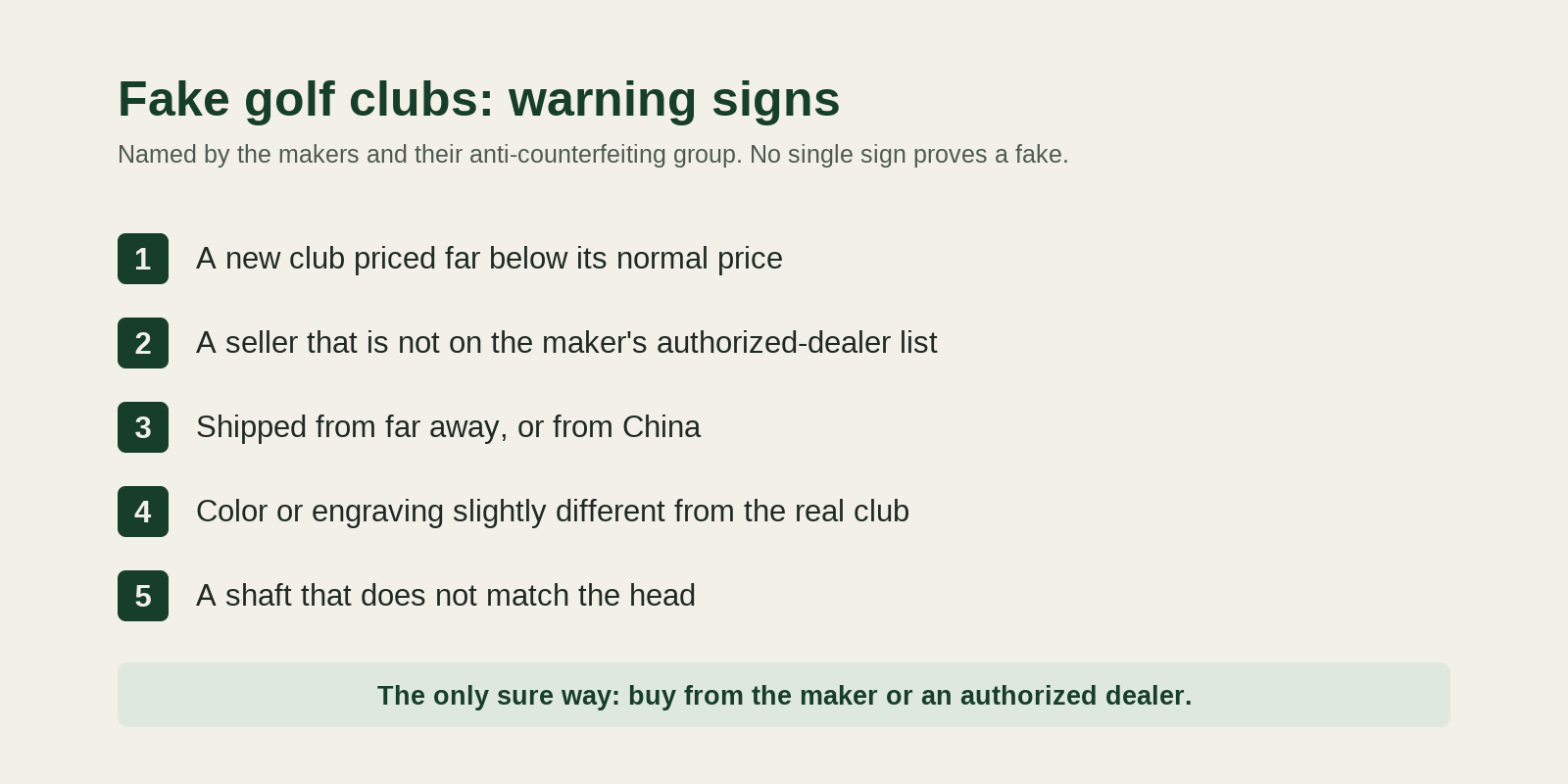
Warning signs the makers name
| Warning sign | Who says it |
|---|---|
| A new club priced far below its normal retail price | PING, Callaway, the industry group |
| A seller that is not an authorized dealer on the maker's own list | The industry group, PXG, PING |
| New clubs offered on online auctions, at big-box stores, discounters or flea markets | PXG (for its own clubs) |
| A seller who says the club was won in a tournament or raffle, or was a gift | Callaway |
| Shipping from far away, or from China | PING, the industry group |
| A website with no reasonable contact details, or a hidden owner | PING |
| Slightly different colors or engravings from the genuine club | The industry group |
| A shaft that does not match the head | The industry group (its PING driver example) |
| Photos of a genuine club in the listing, then a different club in the box | PING |
On color and engraving, the group says most golf makers do not sell "blems" or "seconds", so two versions of the same club should not exist in the market. A head whose paint or engraving differs from the maker's own photos is, in the group's words, "most likely" fake.
Physical checks you can do
PING's advice is to inspect the club in person, side by side with a genuine PING club, because fakes differ in shape, color, markings, finish or insignia, and photos are hard to judge. The group's examples show what that comparison catches: different screws joining the shaft and head on a Callaway driver, a different center weight, shoddy paint and engraving on Scotty Cameron putters.
For a driver or wood with a carbon crown, Callaway says counterfeiters paint metal crowns to look like carbon composite. Tapping the crown with a metal object gives a ping on a fake and a much softer sound on a genuine composite crown.
Every model page on this site shows a product photo of the model with its source and lists the markings that identify that generation, so you can check the badge, cavity and lettering against the photo. Start from the club database or What year is my club? if you do not know the model yet.
Registration and serial numbers settle less than many buyers expect. PING says the product registration tool on its site does not verify authenticity. None of the maker pages we read offers a serial-number lookup; they send you to customer service instead. Our guide to older Titleist serial numbers covers what a serial number can and cannot tell you about one brand.
Buying used clubs
The authorized-dealer rule is about new clubs. A used set from a friend, a garage sale or a marketplace listing will never come with that guarantee, so the physical checks above carry more weight. Callaway names its own certified pre-owned store, Callaway Pre-Owned, as one of the places to buy safely. Whatever the source, ask for close photos of the face, sole, cavity and hosel, and compare them with the maker's images before you pay.
The group says counterfeit clubs are made without the specifications and quality standards of real ones, and that the problems range from lost distance and accuracy to shafts that shatter and heads that fly off mid-swing. Its cutaway photo sets genuine irons, partly hollowed out to their design, beside counterfeits cut the same way.
For everything else to check on a used set (build history, bent lofts, worn grooves, reshafting), see our used iron checklist.
If you think you bought a fake
- Contact the maker first. The industry group says this opens the way to an investigation, and each member's website has a place to report suspected counterfeits. Callaway and PXG give report addresses on the pages linked above; PING asks buyers to report the seller to it and to the authorities.
- Dispute the payment. If you bought on a site like eBay, the group says to file a dispute with the seller immediately. PXG also suggests disputing the credit card charge or filing a PayPal claim and reporting the seller to the auction site.
- Watch your card statement. The group warns that a counterfeit seller now has your card details.
- Do not expect a refund from the maker. Callaway and PXG both say they cannot reimburse you for counterfeit product, and Callaway adds that it cannot repair it.
The group also takes reports of websites that sell fakes through keepgolfreal.com.
Sources and limits
Read on November 21, 2026:
- U.S. Golf Manufacturers Anti-Counterfeiting Working Group: About
- U.S. Golf Manufacturers Anti-Counterfeiting Working Group: FAQ
- U.S. Golf Manufacturers Anti-Counterfeiting Working Group: Spotting the fake
- Callaway Golf: Counterfeit club warning
- PING: Avoiding counterfeit clubs
- PXG: Counterfeit clubs
This guide repeats what these pages say. It cannot tell you whether a particular club is genuine, and it does not cover TaylorMade, Titleist or Cleveland checks beyond the group's shared advice, because their own authenticity pages did not load for us. Counterfeiters change their methods, so a club that passes every check above can still be fake; when in doubt, ask the maker.