
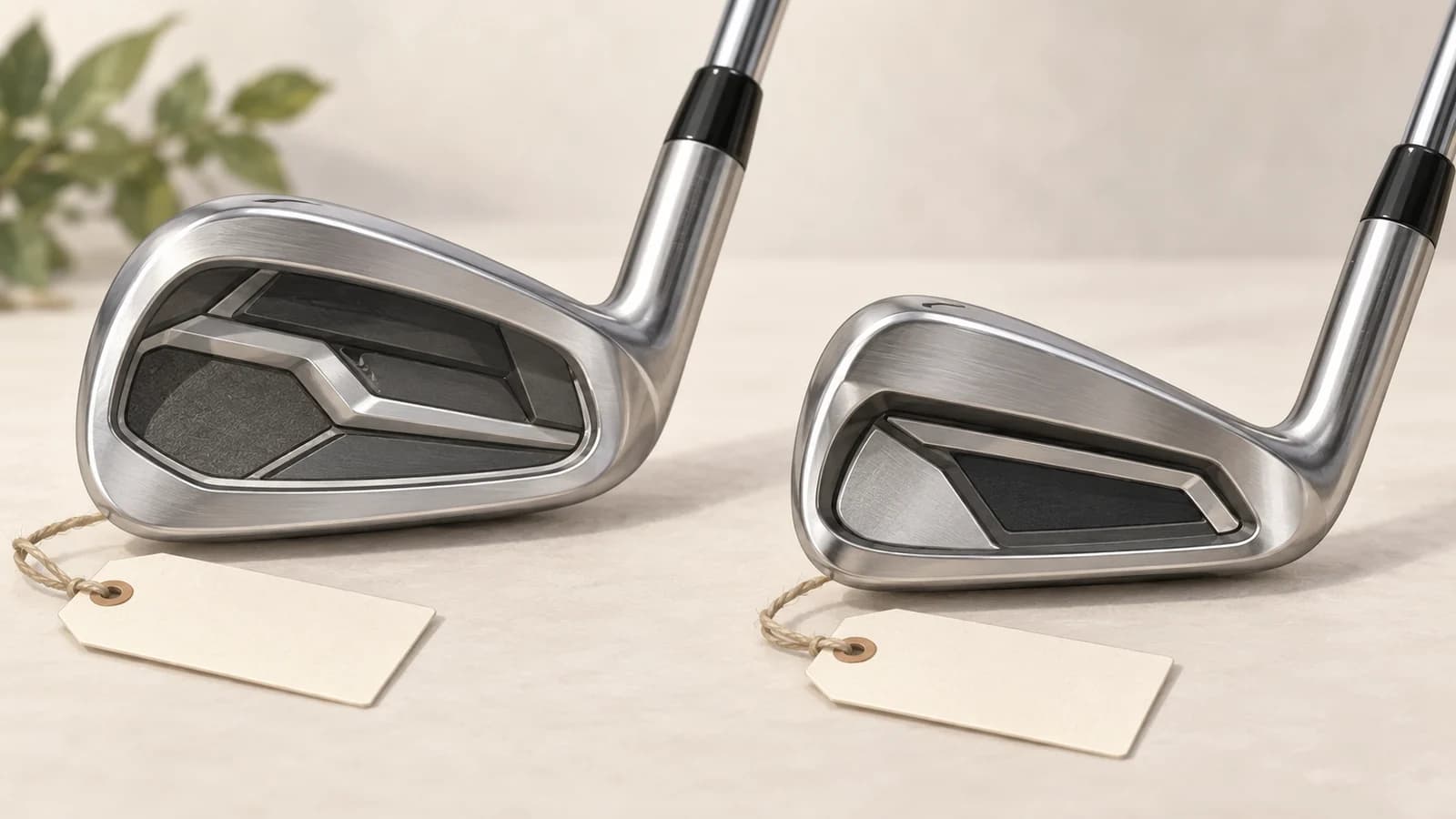
Treat M2 Tour as a separate head model
The TaylorMade product archiveplaces M2 Irons and M2 Tour Irons under 2016, with a separate sheet for each. The M2 Tour sheetdescribes a compact head design. Its specification table also differs from the ordinary M2 sheet. The full name matters when you select factory specifications.
See the complete 2016 M2 chart and 2016 M2 Tour chart, or compare both factory builds side by side.
For a used listing headed simply “2016 M2 irons,” ask the seller to confirm the head model and supply clear cavity, sole and face photographs. Compare those photographs with the relevant source sheet. A title shortened for a marketplace search leaves room for ambiguity; an exact model name attached to actual head photographs gives you a better starting point.
There is a second naming question within the wider M2 family: the ordinary model also appears in a later generation. Our 2016 vs. 2017 M2 articlecovers that comparison. Here, both source sheets come from the 2016 archive, and the distinction is M2 versus M2 Tour.
Compare the right factory figures
These selected values show why the shared M2 name is too broad for a specification lookup. Length uses the ordinary M2 sheet's men's row and the Tour sheet's row labelled LENGTH. All figures are published factory values, with angles in degrees and playing lengths in inches.
| Specification | M2 | M2 Tour |
|---|---|---|
| 7-iron loft | 28.5° | 30.5° |
| 7-iron lie | 63.0° | 62.5° |
| 7-iron length | 37.00 in | 36.75 in |
| Pitching-wedge loft | 43.5° | 45.0° |
The Tour 7-iron has 2° more published loft and a listed length 0.25 inches shorter in these rows. At the pitching wedge, the published loft difference is 1.5°. Those are calculations from the charts. Each comparison needs the club label and the exact model beside it; one difference does not describe the entire set.
These figures establish a difference in the original specifications. Carry distance, launch and a golfer's preferred setup require further evidence. Our loft guideexplains the limits of using an angle to compare playing results. For the complete ordinary-model loft, lie and length rows, use the 2016 M2 reference; keep the linked Tour sheet with any Tour comparison notes.
Use shaft labels as build clues
The ordinary M2 sheet names REAX 88HL as its stock steel shaft. The M2 Tour sheet names True Temper XP 95, with S300 and R300 options. Those entries describe the documented stock offerings and can help you ask a seller about the set's build history.
A shaft label describes the shaft currently in the club. Establish the head identity from the head, then record the shaft model and flex separately. Ask whether the set was custom ordered or reshafted, and keep any supplied documentation with that record. The Tour sheet also lists graphite as custom only, so a steel stock listing is an incomplete picture of the possible original builds.
Avoid making a shaft name stand in for the full iron-model name. That shortcut can send the next reader back to the wrong chart, even when the shaft transcription itself is accurate.
Resolve an ambiguous used listing
Before comparing a seller's measurements with either sheet, gather a small record of the actual set:
- Full head model, with clear photographs of its markings and shape.
- Every club label included, including separately listed wedges.
- Current shaft model and flex, plus any disclosed replacements.
- Disclosed loft, lie or length changes, and any measurements with their method and date.
Our set-makeup guidehelps decode the clubs included in a listing, while the used-iron checklistcovers condition and alteration questions. A manufacturer's range of available clubs and a seller's inventory answer different questions.
Keep an unresolved head identity marked as unresolved. Once it is established, attach the correct source sheet to the record and compare its factory values with separately documented current measurements. That preserves the two things a useful listing needs: which heads are offered and what is known about their present build.
Sources and scope
Reviewed October 4, 2026: the US TaylorMade Product Specs by Year archive, its 2016 M2 Irons product sheet, and its 2016 M2 Tour Irons product sheet. The table above independently transcribes four selected specifications; source charts, photographs and marketing claims are not reproduced.
The archive year identifies the documents used in this comparison. It establishes no manufacture date for an individual club. No clubs were inspected, measured or tested for this article, and the comparison offers no fit or compatibility finding.