
The short answer
Titleist has released a new Pro V1 every two years since 2003, and each release gets a sidestamp that no earlier ball used. Titleist's own sidestamp history lists 14 designs, from 2000 to 2025. That makes the sidestamp the most reliable way to date a loose ball:
- Turn the ball until you can read the model name on its equator.
- Check the name. Pro V1 has been made since 2000, Pro V1x since 2003, and a dash in front of the name (–Pro V1x) means the Pro V1x Left Dash.
- If a three-digit number follows the name, read the 392 and 332 section.
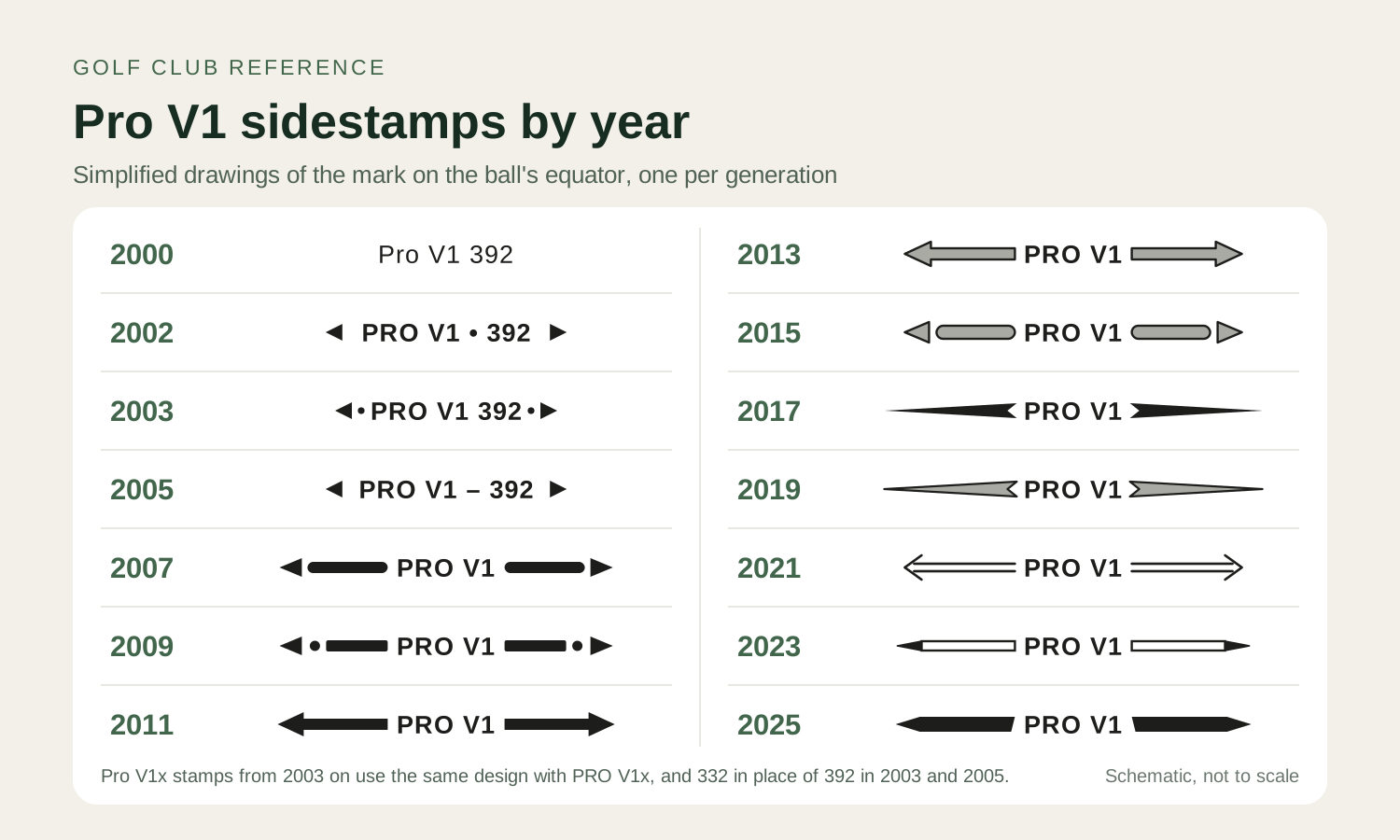
- If not, compare the marks on each side of the name with the drawings below.
Pro V1 markings by year, 2000 to 2025
The year in this table is the generation's launch year. A generation usually stays in shops until the next one arrives, so a 2015 ball can just as well have been bought in 2016.
| Generation | Models | What the sidestamp shows |
|---|---|---|
| 2000 | Pro V1 | Plain block lettering and the number 392. No arrows, dots or lines. |
| 2002 | Pro V1 | Small arrowheads at both ends and a dot between V1 and 392. |
| 2003 | Pro V1, Pro V1x | Small arrowheads with a dot just inside each one. The Pro V1x arrives and prints 332. |
| 2005 | Pro V1, Pro V1x | Small arrowheads, no dots, and a dash before the number. The last generation that prints 392 or 332. |
| 2007 | Pro V1, Pro V1x | The first A.I.M. stamp: a thick black bar with rounded ends on each side of the name, then a separate arrowhead. No number. |
| 2009 | Pro V1, Pro V1x | Black bars and arrowheads like 2007, with a round dot between each bar and its arrowhead. |
| 2011 | Pro V1, Pro V1x | One-piece solid black arrows, shaft and head joined, beside the logo-style lettering. |
| 2013 | Pro V1, Pro V1x | The same one-piece arrow shape, filled grey with a black outline. |
| 2015 | Pro V1, Pro V1x | A grey bar with rounded ends, a small gap, then a separate arrowhead on each side. |
| 2017 | Pro V1, Pro V1x | Long, thin solid black wedges, widest next to the name and tapering to a sharp point at each end. |
| 2019 | Pro V1, Pro V1x | The tapered 2017 shape again, but filled grey with a black outline. |
| 2021 | Pro V1, Pro V1x | Outlined arrows: two thin parallel lines for each shaft and an open arrowhead. |
| 2023 | Pro V1, Pro V1x | A thin outlined bar on each side that ends in a short, solid pointed tip. |
| 2025 | Pro V1, Pro V1x | Solid black bars with angled, chisel-cut tips at the outer ends. Titleist calls them chiseled wings. |
The Pro V1x stamp follows the Pro V1 design of the same year with an x added. We checked this against Titleist's photos of both models for every generation from 2003 to 2021 and for the current Pro V1x on Titleist's product page.
Pro V1 392 and Pro V1x 332
The number on early balls is the dimple count. The original 2000 Pro V1 had 392 dimples, and Titleist introduced the Pro V1x in 2003 with a 332-dimple design. Both numbers were printed on the sidestamp through the 2005 generation. From 2007 the name stands alone, so a ball that says Pro V1 392 belongs to a generation launched between 2000 and 2005, whatever condition it is in.
The four numbered generations differ in small details:
- 2000: just the words Pro V1 392, with no arrows or dots. Titleist shows two versions with different letter spacing.
- 2002: a small arrowhead at each end and a dot between V1 and 392.
- 2003: small arrowheads, each with a dot just inside it, and no dot before the number. The first Pro V1x reads Pro V1x 332.
- 2005: small arrowheads without dots and a short dash before the number.
Later Pro V1 balls still have dimple counts, 388 on the 2025 Pro V1 and 348 on the 2025 Pro V1x according to Titleist's launch details, but they are no longer printed, and counting them by hand is not a practical way to date a ball.
Telling the arrow years apart
In 2007 Titleist added what it called A.I.M., Alignment Integrated Marking: long bars on either side of the name that you can line up with your target. Every generation since has changed the shape of those bars. The easiest ones to confuse:
- 2007 vs. 2009: both have thick black bars and separate arrowheads. The 2009 stamp has a round dot between each bar and its arrowhead.
- 2011 vs. 2013: both use a one-piece arrow, with shaft and head joined. On 2011 balls it is solid black. On 2013 balls it is grey with a black outline.
- 2013 vs. 2015 vs. 2019: all three are grey. The 2013 arrow is one piece, the 2015 stamp has a rounded grey bar with a small gap before the arrowhead, and the 2019 shape is a long, thin taper to a point with no separate head.
- 2017 vs. 2019: the same tapered shape, solid black in 2017 and grey with an outline in 2019.
- 2021 vs. 2023 vs. 2025: 2021 has outlined arrows made of two thin parallel lines and an open head. The 2023 bar is a thin outline ending in a short solid point. In 2025 the bars are solid black with angled tips that Titleist calls chiseled wings.
Wear can hide these details. A scuffed ball may have lost the dot of a 2009 stamp or the thin outline of a 2023 one, so check both sides of the name, under good light.
Extra lines and colored arrows
Not every Pro V1 has the standard stamp. Titleist sells Enhanced Alignment versions with two long lines above and below the name; its sidestamp history shows them on 2019 balls, and the 2021 launch made them a stock option. On the 2025 version the stamp itself is about 65% longer than standard, with the two extra lines. The arrows between the lines still follow the design of their generation, so read those as usual.
A colored arrow on the opposite side of the ball is a separate option. Titleist's Performance Alignment, announced in August 2023, prints a long arrow there, and custom orders can carry other logos and markings. They don't replace the sidestamp, so turn the ball until you find the model name.
Limited editions use the normal design in a different color or theme. Titleist's history, for example, includes a 2014 Pro V1 Pink with a pink sidestamp.
Pro V1x Left Dash markings
A ball marked –Pro V1x, with a dash in front of the name, is the Pro V1x Left Dash, a lower-spin version of the Pro V1x. Titleist developed it in 2018 as a custom option, and its sidestamp history places the first Left Dash under 2019, with the dash before the name and solid black tapered arrows. The second Left Dash went on sale on January 21, 2026, with a new 348-dimple design.
We haven't compared the two Left Dash stamps closely enough to describe the difference, so for a loose –Pro V1x ball the box or the seller's listing is the safer way to tell 2019 stock from 2026 stock.
What the sidestamp can't tell you
The sidestamp dates the design of a ball, not the day it was made or bought. Balls from a generation can sit in a shop, a garage or a lake for years before you find them. A worn stamp can also leave you choosing between two neighboring years.
Whether an old ball is still worth playing depends more on how it was kept than on its age. In an April 2012 reply on the Team Titleist forum, the official Team Titleist account quoted the company's golf ball R&D team: its balls can be stored for five years or more if kept away from excessive heat, and attics and cars can get hot enough to shorten a ball's life. It is a general statement from 2012. It doesn't describe a test of any particular ball, and it doesn't cover balls that sat in water.
The same idea runs through our What year is my club? tool and the guide to identifying older golf irons: a printed mark points to a model generation, and a date of manufacture needs other evidence. For Titleist clubs, the serial number guide explains what Titleist's records can and cannot add, and the Titleist reference pages list the clubs we have sourced. If you want to know how spin and launch shape the flight of whichever ball you play, the launch and spin guide covers that.
Sources and limits
Reviewed October 12, 2026. The generation list and the sidestamp descriptions come from Titleist's own pages: Pro V1 and Pro V1x Sidestamps Throughout the Years (Team Titleist, April 1, 2020), the 2025 Pro V1 sidestamp FAQ, No Detail Too Small: New Pro V1 and Pro V1x Sidestamps (March 9, 2021), the 2026 Left Dash announcement (January 7, 2026) and the current Pro V1x product page. The 2025 dimple counts and the longer 2025 Enhanced Alignment stamp are from Golf.com's 2025 launch report; the Performance Alignment arrow is described by AmateurGolf.com; the storage statement is from the official Team Titleist account's April 10, 2012 forum reply quoting Titleist R&D. Golf.com's 2020 guide was read for comparison.
The descriptions are our reading of Titleist's photographs, and the drawings are simplified redrawings, not Titleist artwork. We did not inspect, measure or test any golf balls. Yellow and other colored balls, custom logos, special editions and Left Dash stamps beyond those named here were not reviewed one by one. This guide covers Titleist Pro V1 models only; other balls and brands have their own markings, and we found no comparable published history for them.