
Choose a length, then a set design
A conventional set with different iron lengths is a sensible starting point if you already like its setup and get useful gaps between clubs. A purpose-built single-length set is worth trying if a more repeatable address position appeals to you. Neither choice settles the fitting question.
Women's clubs belong in that same comparison whenever their actual build suits the player. A man can use them; a woman can use a set sold as men's. Length, weight, shaft response, lie angle and grip size provide more useful buying information than the category on the box.
Why conventional irons get shorter
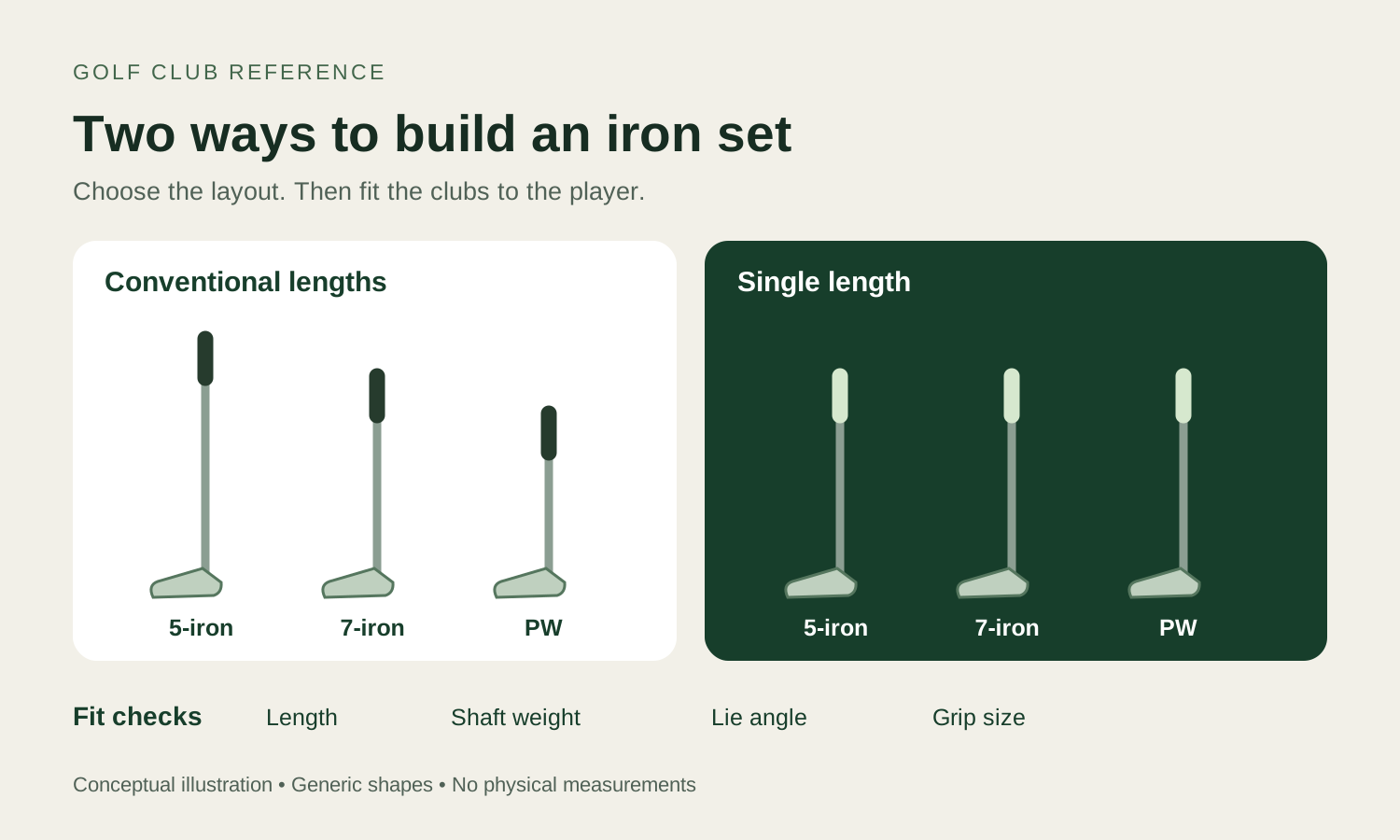
Conventional sets pair longer, lower-lofted irons with progressively shorter, higher-lofted irons. This gives the clubs different address geometries as well as different lofts. Length and loft both matter to the comparison; a printed club number supplies only part of the story.
Here is a concrete factory example. The 2022 Cobra catalog lists three LTDx builds on printed pages 22–24 (PDF pages 22–24). Selected complete-club lengths are in inches.
| Club | LTDx conventional | LTDx ONE Length | LTDx Women's |
|---|---|---|---|
| 5-iron | 38.50 | 37.25 | 37.50 |
| 7-iron | 37.25 | 37.25 | 36.25 |
| PW | 36.00 | 37.25 | 35.00 |
Keep the catalog's note with these figures: an Arccos grip adds 0.25 inches in custom builds. The conventional and ONE Length pages list steel and custom graphite options; the women's page lists a graphite build. This is a historical example, rather than a universal size chart.
There is also no universal “standard 7-iron length.” Compare the exact model, generation and build, then measure the actual clubs. Our measurement guide covers methods; the length converter handles inches and centimeters.
The case for single-length irons
The appeal is fewer setup changes through the iron set. Wishon's single-length design explanationdescribes matching length and other build characteristics to support repeatability. That is a design rationale, with improvement left to testing.
The clubs still have different lofts and are intended to cover different shots. Equal length does not mean equal carry distance. Equally, loft differences alone cannot establish your carry gaps; measure those with shots. Our loft guideexplains how to read that part of the specification.
One length can also mean different lengths in different products. Wishon's discontinued Sterling designallowed builds at 36.5, 36.75 or 37 inches. The common length itself still needs choosing for the golfer.
Equal length also leaves room for differences elsewhere in the build. Cobra's LTDx ONE Length chart varies lie angles and stock steel shaft models through the set. Read each product's own specifications before assuming every single-length design uses identical components.
In everyday use, “single-length irons” describes the iron set and whichever wedges or hybrids are specifically included. Your driver, fairway wood and putter can retain their own lengths. Check the set inventory, especially when buying used.
Test the longest iron and the wedge
A comfortable 7-iron tells you little about the extremes of a new set. Try its lowest-lofted iron and pitching wedge as well. Wishon's Sterling design notes describe different head constructions to address low-loft launch and distance spacing at a shared length. Engineering the set involves more than matching shafts.
At the long end, record whether successive clubs produce distinct carry distances and a flight you can use. If the lowest-lofted iron repeatedly finishes beside the next iron, discuss a different set makeup, including a hybrid, before buying a club you rarely use.
At the short end, try full wedge shots, a partial pitch and your normal chip. The longer wedge may feel unfamiliar beside your present wedge. That makes it a useful part of the trial, even if the mid-irons feel immediately comfortable. You may prefer separate conventional-length specialist wedges, with their gaps checked alongside the iron set.
Beginners can value a repeatable setup; experienced golfers can value the same thing. Handicap alone supplies no verdict. Judge the actual tradeoff between comfortable setup, strike consistency and useful shots.
Can a man use women's clubs?
Yes. Treat them as a candidate build and check the specifications. A shorter player seeking a lighter club has a practical reason to try one. A shorter player who prefers a heavier or stiffer shaft may find a custom-length alternative more suitable. Height and gender alone establish neither result.
Differences can include length, shaft weight and flex, grip size, swingweight, loft and set makeup. Verify which ones apply to the exact model. For example, PING's G Le3 US specifications list a 36.5-inch 7-iron and ULT 250 i shafts at 45 grams (Ultra Lite) or 52 grams (Lite). Those are shaft weights, rather than complete-club weights. The page lists both iron and hybrid options.
A used listing that says “ladies flex” leaves several questions open. Ask for the shaft model, actual length, grip and any modifications. Keep the printed flex label with its model; it cannot predict how another manufacturer's shaft will feel to you.
The same reasoning runs the other way. A woman who prefers a longer, heavier or different-flex build can compare men's and custom options. Buy the combination that works in a trial. Color and marketing category add no evidence about your strike pattern.
Height is a starting measurement
Two golfers of the same height can have different arm lengths and address positions. PING's fitting process starts with measurements including height, wrist-to-floor and hand size, then refines the initial specifications using shots and launch information. Follow a fitting system's measurement instructions consistently when using its chart.
Reaching for the ball, standing unusually upright or feeling crowded are reasons to investigate your setup. A recurring heel or toe strike is another useful observation. Each can have several causes, including technique, so record what happens before prescribing an extra inch or cutting an inch off every club.
Compare length alongside lie angle, shaft weight and grip. A recommendation such as “half an inch shorter” also needs a reference model: half an inch shorter than which stock specification?
Before cutting or extending a set
Cutting a conventional set to one length changes more than reach. Its heads were built for different lengths; matching the shaft ends leaves the original head weights and lie angles to address. Wishon's conversion discussionexplains why converting an ordinary set is impractical compared with testing a purpose-built design.
Even a smaller length change deserves a build check. PING's G Le3 notes explicitly connect achievable swingweights with the combination of shaft, length and grip. Ask a repairer to assess those factors, shaft or extension condition and the head's adjustment limits before agreeing to modifications across a used set.
Gripping down can be a quick, reversible way to explore a shorter hand position. Your hands move onto a different part of the grip, and the original club remains intact, so treat the trial as a clue rather than an exact simulation of a rebuilt club. For a young player, compare a suitable junior build too; a cut-down adult club still retains its adult components and weight.
A practical comparison session
Bring a familiar mid-iron, your longest regularly used iron and a wedge. Use them as a baseline beside the candidate set. The aim is to learn whether the whole set helps, rather than reward one unusually good shot.
- Write down the builds. Record model, club number, measured length, shaft model and grip. Note loft differences when comparing the same club number across sets.
- Alternate the clubs. Hit several ordinary shots with each option using the same balls and conditions. Keep normal misses in the record; note obvious mishits separately.
- Record useful outcomes. Track carry, left/right spread, strike location and comfortable posture. Compare the typical shots as well as the best one.
- Check both ends. Test the low-loft iron's separation from its neighbor and the wedge's full and partial shots.
- Give an unfamiliar setup practice time. If the first session is inconclusive, repeat it before paying for a full set or permanent alterations.
Enter your measured carries in the bag gap analyzer to see adjacent average-distance gaps. Retain your shot spread separately; averages can hide overlap. Our used-iron checklisthelps document the actual build before purchasing.
Keep a conventional set if it gives you the shots you need. Choose single length if its simpler setup holds up through the long iron and wedge trials. Choose a women's or custom build when its specifications and your results support it. The most useful purchase record is the build you tested and the shots it produced for you.
Sources and scope
Sources reviewed October 5, 2026: Cobra's 2022 catalog (printed pages 22–24, PDF pages 22–24), PING's fitting process, US G Le3 specifications, Wishon's single-length Q&Aand Sterling design notes. Manufacturer performance statements describe their own designs; they supply no independent comparative test here.
This is an editorial decision guide with selected factory facts and a suggested comparison session. We measured or tested no clubs for this article. An older club's current length and build need checking separately from its factory chart.